Why do welders use pipe rotators during fabrication?
Posted onPipe rotators solve the toughest challenges in fabrication — better welds, safer work, and narrower skill gaps.
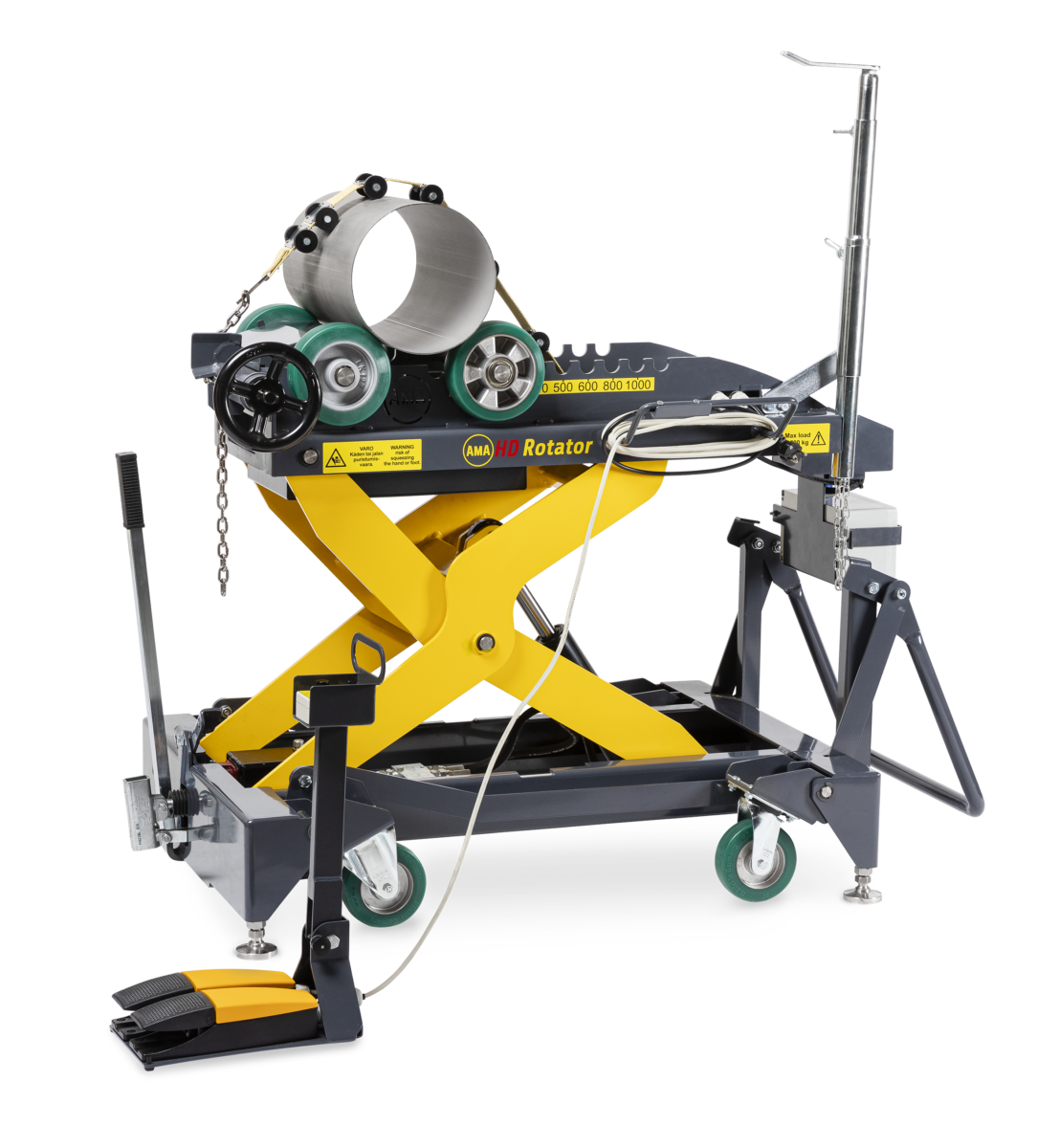
If you have ever watched a skilled welder work on a pipe joint, you know how much physical effort goes into maintaining a consistent position around a curved surface. Pipe welding is demanding work, and the quality of the finished weld depends heavily on the welder’s ability to keep a steady hand, a stable arc, and a consistent travel speed throughout the joint. That is where pipe rotators come in. These motorized pipe handling tools rotate the pipe at a controlled speed so the welder can stay in one ergonomic position while the work moves to them, rather than the other way around. The result is a more consistent weld, a safer working environment, and a noticeably more productive prefabrication process.
Whether you work in process industry pipe prefabrication, run a prefabrication workshop, or manage a site installation crew, understanding how and why pipe rotators work helps you make better decisions about your welding setup. This article walks through the practical reasons why professional welders use pipe rotators, what challenges they solve, and what to look for when selecting one.
What makes pipe rotation critical for weld quality
Consistent weld quality in pipe welding depends on three variables that are difficult to control simultaneously when welding manually: arc travel speed, torch angle, and heat input. When a welder works around a stationary pipe, all three variables shift constantly as the body moves from the flat position down into the vertical and eventually into the overhead position. Each positional change demands a different technique, and the transitions between them are where defects most often appear.
When the pipe rotates at a controlled speed instead, the welder maintains the flat or slightly uphill position throughout the entire weld. Travel speed becomes consistent because the rotation speed is set and does not fluctuate with the welder’s movement. The torch angle stays fixed, and heat input remains predictable.
Industry experience shows that this single change produces welds with fewer inclusions, more uniform penetration, and a surface finish that is noticeably closer to what you would expect from an automated system. For materials like stainless steel or duplex alloys, where heat management is especially important, this level of control makes a real difference in the final result.
The flat position advantage
Welding in the flat position is the most controllable and the most forgiving. Gravity works with you rather than against you, the molten pool behaves predictably, and the welder can focus attention on maintaining the arc rather than compensating for body position. Pipe rotation keeps the weld pool in this ideal zone throughout the joint, which is why pipe welding professionals consistently report that rotator-assisted welds look and perform better than manually welded equivalents.
Key challenges in manual pipe welding
Manual pipe welding without rotation support puts significant physical and technical demands on the welder. Moving around a pipe requires constant repositioning of the body, the welding torch, and sometimes the pipe itself. This interrupts the arc, introduces inconsistency into the weld bead, and slows down the entire process.
Beyond weld quality, there are practical productivity challenges:
- Tack welding requires stopping and starting repeatedly.
- Brushing stainless steel seams between passes means reaching into awkward positions.
- Cutting with an angle grinder on a stationary pipe means working around the circumference rather than letting the work come to you.
Each of these tasks takes longer, tires the welder faster, and introduces more opportunity for variation between individual welders. In a team environment, differences in skill level and physical capability show up directly in the consistency of the finished product.
The skill gap problem
One of the less-discussed challenges in pipe welding is the variation in output quality between welders of different experience levels. Senior welders develop techniques for managing positional changes that take years to master. Newer welders struggle with overhead and vertical positions in particular.
When pipe rotation handles the positional challenge, the gap between skill levels narrows significantly, and the output of a competent but less experienced welder becomes much closer to that of a specialist. For supervisors and project managers, this means more predictable quality across the whole team.
How pipe rotators support safer working environments
Ergonomics and safety are closely connected in welding work. Repeated overhead welding, awkward crouching positions, and the physical effort of repositioning pipes all contribute to musculoskeletal strain over a career. Back injuries, shoulder problems, and repetitive strain conditions are common in environments where manual pipe handling is the norm.
Pipe rotators reduce these risks by keeping the welder in a stable, upright, and ergonomically sound position throughout the work:
- No need to crouch under the pipe for overhead passes.
- No need to reach awkwardly for vertical sections.
- No need to physically roll or reposition a heavy pipe between passes.
Manually moving a heavy pipe without proper support creates a genuine risk of crush injuries and dropped loads. A motorized rotator with a stable pipe stand system removes that risk from the workflow entirely.
Foot pedal operation, which is standard on professional pipe rotators, means the welder controls rotation speed and direction without taking their hands off the torch or the work. This keeps the welder fully in control of the process at all times and reduces the chance of unexpected pipe movement during welding.
What professional-grade pipe rotators actually do
A professional pipe rotator does more than simply spin a pipe. It gives the welder precise control over rotation speed and direction, handles a wide range of pipe diameters without requiring significant setup changes, and integrates with a pipe stand system that keeps the pipe stable and at the right working height throughout the job.
The AMA Roller pipe rotator, for example, handles pipe diameters from 30 mm to 508 mm and supports all standard manual welding methods including MIG, MAG, TIG, and covered electrode arc welding. The foot pedal control lets the welder adjust speed and direction without interrupting the weld. For heavier applications, the AMA HD Rotator Set handles diameters up to 1,000 mm with battery or mains operation, hydraulic height adjustment, and a roller belt system that keeps the pipe firmly seated against the drive wheels.
Read more about the AMA Roller pipe rotator and its full specifications.
Beyond the core rotation function, professional rotators also streamline adjacent tasks:
- Cutting with an angle grinder becomes faster because the pipe rotates to the cutter.
- Cleaning back welds and brushing stainless seams between passes happens from a fixed position.
- Tack welding runs continuously without interruption, producing a tack bead consistent enough to resemble a robot weld in appearance.
These secondary benefits add up to meaningful time savings across a full prefabrication project.
Standard vs. premium rotator options
Entry-level professional rotators offer motorized rotation with foot pedal control and adjustable speed. Premium versions add wireless Bluetooth control, which allows the welder to operate the rotator from up to 25 meters away.
This is particularly useful when working with long pipe sections where the welder may be positioned far from the drive unit, or on sites where reducing cable clutter improves safety and workflow. The choice between standard and premium depends on the scale of your typical jobs and how much flexibility you need in positioning.
Selecting the right pipe rotator for your needs
Choosing a pipe rotator starts with understanding the range of pipe diameters and weights you work with most often. AMA rotators are designed to cover a broad range of pipe sizes, from small-diameter tubing to large-bore industrial pipe, so there is a suitable option whether you are working in a prefabrication workshop or on a process industry site.
Beyond diameter and load, consider how the rotator integrates with your existing pipe stand setup. A rotator that mounts directly onto a compatible pipe stand system gives you a stable, height-adjustable working platform that handles a wide range of pipe sizes without needing separate support equipment for each job.
Portability matters too, particularly for site work. A rotator that moves easily on wheels and mounts quickly to a pipe stand with a quick-release fastener saves setup time and makes it practical to bring the equipment to the pipe rather than the other way around.
- Pipe diameter range: Match the rotator’s capacity to the diameters you work with most frequently, with some headroom for larger jobs.
- Load capacity: Heavier pipes and longer sections require higher load ratings across both the rotator and any supporting stands.
- Control options: Foot pedal control is standard; wireless Bluetooth control adds flexibility for long pipes or complex site layouts.
- Portability: Wheels, quick-release mounting, and manageable weight all affect how practical the equipment is for site use.
- Welding method compatibility: Confirm that the rotator and its drive wheels are compatible with your primary welding process and pipe surface materials.
- Voltage and power requirements: Check that the rotator’s electrical specifications match your workshop or site supply.
Accessories also deserve attention. Rubber wheel sets improve grip on pipes with longitudinal seams or uneven surfaces. Counterweight systems handle pipes with elbows or projecting parts that would otherwise make rotation unstable. Investing in the right combination of rotator, pipe stands, and accessories gives you a pipe handling system that works reliably across a wide range of scenarios rather than just the straightforward ones.
Pipe rotators are one of the most practical investments a pipe welding workshop or site team can make. They improve weld consistency, reduce physical strain on welders, speed up adjacent tasks like cutting and brushing, and narrow the quality gap between welders of different experience levels.
At Welner, we design and manufacture the AMA Roller pipe rotator range in Finland, building tools specifically for professional pipe welding in process industry environments. We also offer the full AMA pipe handling system including pipe stands, centering collars, purge kits, and heavy-duty rotator sets for demanding applications.
If you want to talk through which setup fits your needs, contact us directly and we will help you find the right solution. You can also find your nearest authorized dealer and get hands-on support from a local specialist in your region.