Improve Pipe Welding Efficiency and Weld Quality with Better Pipe Rotation
Posted on)
Introduction
Pipe welding efficiency and weld seam quality are two of the most important factors in industrial fabrication. In long pipe welding especially, small inefficiencies in handling and rotation can lead to inconsistent welds, longer production times, and unnecessary rework.
One of the simplest ways to improve results is to control how the pipe is rotated during welding.
Common problems in pipe welding
Many welders face the same challenges in daily work:
- unstable or uneven pipe rotation
- frequent repositioning during welding
- fatigue from manual pipe handling
- inconsistent weld seam quality
- long cycle times in fabrication
These issues become more significant in stainless steel and precision pipe welding, where consistency is critical.
Why pipe rotation affects weld quality
A stable and controlled pipe rotation helps the welder maintain:
- even heat distribution along the seam
- consistent welding speed
- stable arc control
- cleaner and more uniform welds
When rotation is manual or inconsistent, weld quality can vary significantly between welds and operators.
Better control = better efficiency
Improving pipe welding efficiency is often not about welding faster, but about removing unnecessary interruptions.
Controlled rotation helps to:
- reduce pipe repositioning
- keep the welder in a stable working position
- minimize downtime during welding
- improve repeatability in production
This leads to faster and more reliable fabrication processes.
AMA Roller® Premium Pipe Rotator with remote
A practical solution for improving both efficiency and weld quality is the AMA Roller® Premium Pipe Rotator with remote.
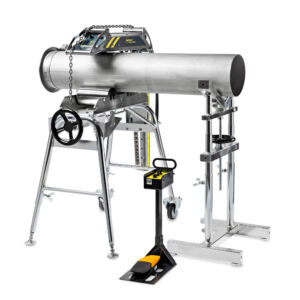
It is designed for workshop and on-site pipe welding and provides controlled, adjustable pipe rotation.
Key benefits include:
- wireless Bluetooth remote control (up to 25 m)
- adjustable rotation speed via foot pedal or control unit
- consistent and smooth pipe rotation
- reduced manual handling of pipes
- improved weld seam quality and consistency
- suitable for MIG, MAG, TIG, and stick welding
- supports ergonomic single-position welding
- faster tack welding and assembly work
By stabilizing pipe rotation, the AMA Roller® helps welders focus on welding instead of handling and repositioning the pipe.
Ergonomics in daily welding work
Pipe welding often involves long working sessions in difficult positions. A controlled rotation system improves ergonomics by:
- reducing physical strain
- allowing a fixed working position
- improving control over the weld
- reducing fatigue over long shifts
Better ergonomics also leads to more consistent weld quality throughout the workday.
Where pipe rotators are used
Pipe rotation systems are commonly used in:
- stainless steel fabrication
- industrial piping systems
- shipbuilding and offshore projects
- energy and power plant construction
- HVAC and process piping
In all these applications, consistency and productivity are key requirements.
Conclusion
Improving pipe welding efficiency starts with controlling the welding process. Stable pipe rotation reduces variation, improves weld quality, and increases productivity.
Solutions like the AMA Roller® Premium Pipe Rotator with remote help welding teams achieve more consistent results with less effort and better ergonomics.