How to support heavy pipes during welding?
Posted onPoor pipe support risks weld failure and injury. Discover the professional methods that keep heavy pipes stable.
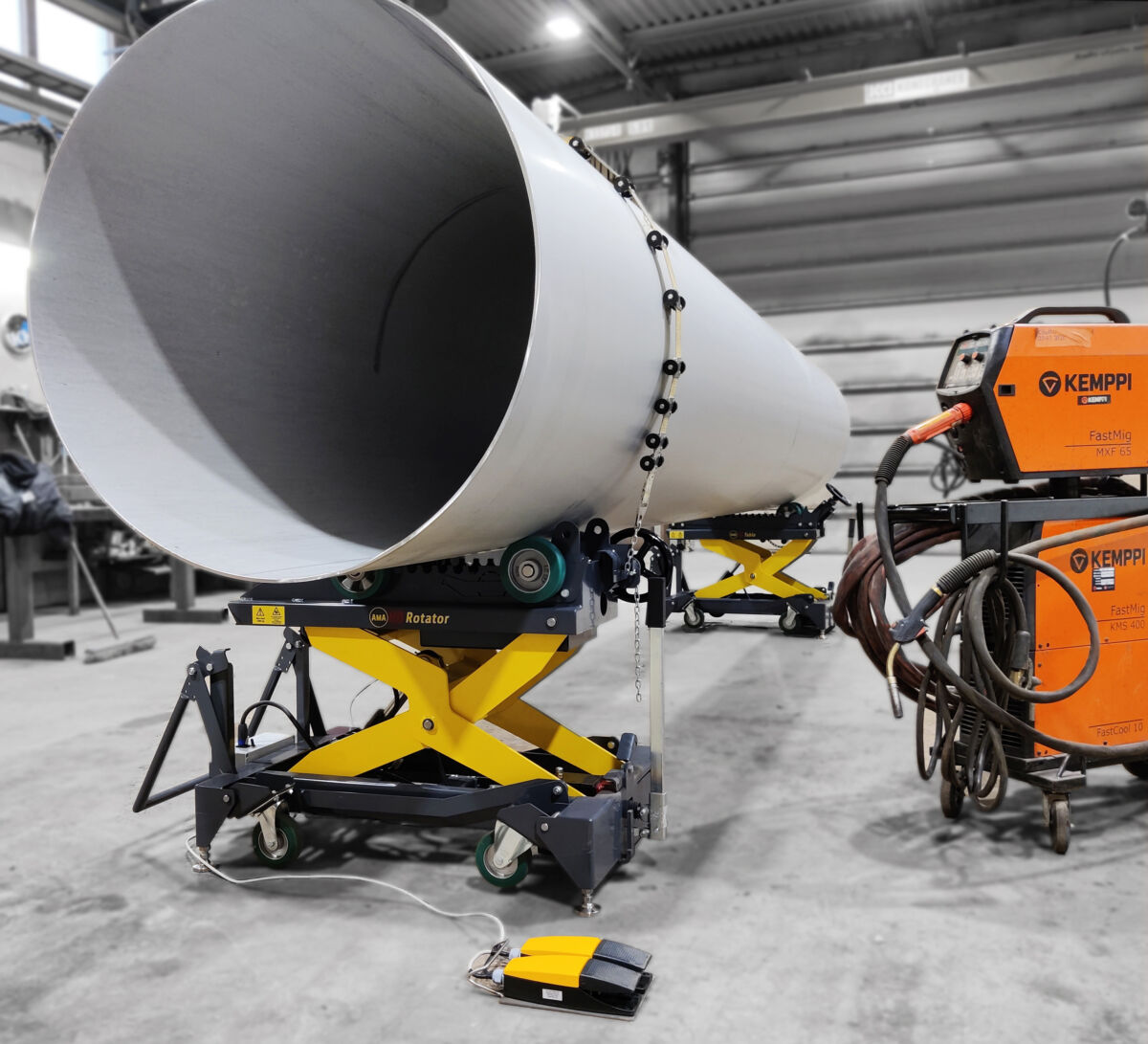
Supporting pipes during welding is one of those challenges that looks straightforward on paper but creates real problems on the job. When you are working with pipes in process industry environments — whether standard diameter or heavy-wall — poor support directly affects weld quality, worker safety, and how efficiently the whole job gets done. Whether you are a welder looking for better equipment, a project manager, or a site supervisor, understanding the fundamentals of pipe welding support helps you make better decisions before the first arc is struck.
The real risks of unsupported pipes during welding
When a pipe is not properly supported during welding, the consequences go well beyond a minor inconvenience. Unsupported weight creates stress at the weld joint, which can cause misalignment mid-weld or introduce distortion into the finished seam. In process piping applications, where dimensional accuracy and joint integrity are non-negotiable, these problems can mean costly rework or failed inspections.
There is also a direct safety dimension. A pipe that shifts unexpectedly during welding can injure the welder, damage adjacent equipment, or cause the entire pipe assembly to drop. In industrial settings, pipes can weigh hundreds of kilograms, and even a small movement under load is a serious hazard. Proper pipe support during welding is not just a quality measure — it is a basic site safety requirement.
Common failure points
- Joint gap changes during welding due to pipe movement
- Angular misalignment caused by uneven weight distribution
- The welder is forced into awkward positions to compensate for poor pipe height
- Pipe rolling or rotating unintentionally on improvised supports
What makes heavy pipe support fundamentally different
Supporting a light pipe and supporting a heavy pipe are genuinely different engineering problems. With smaller, lighter pipes, simple V-blocks or basic stands often provide enough stability. With heavy pipes, you are dealing with much higher loads, greater inertia when the pipe moves, and a stronger tendency for the pipe to shift or roll unless it is actively restrained.
Heavy pipe welding also introduces a challenge around height adjustment. A welder working on a large-diameter pipe needs the pipe positioned at a height that allows ergonomic access to the full weld seam. Adjusting height with a loaded pipe on the stand requires equipment that can handle the load while being repositioned — which rules out many lightweight or improvised solutions. The support system needs to be sturdy enough to hold the pipe securely and flexible enough to allow controlled rotation and height changes during the job.
Another factor that sets heavy pipe support apart is the need to manage long pipe runs. A single pipe section may extend several metres, and a single support point at the centre is rarely sufficient. Multiple support points, properly spaced, prevent sagging and keep the pipe axis straight — which is directly relevant to achieving good pipe alignment welding results at every joint.
Key factors in choosing the right pipe support method
Choosing the right pipe support method starts with understanding the specific demands of your application. Pipe diameter, wall thickness, material, and total weight all influence what kind of support is appropriate. A support system rated for standard carbon steel pipes may not be suitable for larger stainless steel pipes where surface contact matters for avoiding contamination.
Questions to work through before selecting a support method
- What is the pipe diameter and weight? Load capacity must exceed the actual pipe weight with a reasonable safety margin.
- Does the pipe need to rotate during welding? Rotating the pipe rather than repositioning the welder significantly improves seam consistency.
- What is the working environment? Workshop and prefabrication conditions differ from on-site conditions in terms of portability and robustness requirements.
- What pipe material is involved? Stainless steel and acid-resistant pipes require contact surfaces that will not contaminate the material.
- Is height adjustment needed under load? Some applications require adjusting the pipe height after it is already positioned on the stand.
The answers to these questions define whether you need a basic adjustable pipe stand, a motorized pipe rotator, or a more comprehensive heavy-duty rotator system. Matching the support method to the actual job conditions is what separates a smooth welding process from one that creates constant interruptions and adjustments.
Best practices for stable pipe positioning before welding
Good pipe positioning starts before any welding equipment is switched on. The pipe should be placed on supports that hold it at a consistent height along its full length, with enough contact points to prevent any sagging or lateral movement. For longer pipe sections, this typically means at least two support points — and often more depending on pipe length and weight.
Pipe alignment is one of the most important steps in welding preparation. Misalignment at the joint, even by a few millimetres, creates uneven weld gaps that are difficult to fill consistently and can weaken the finished joint. Using a centering collar or alignment tool to bring the pipe ends into precise coaxial alignment before tack welding locks in the correct position and prevents the joint from drifting during the welding process.
Practical positioning checklist
- Set all support stands to the same height before placing the pipe
- Check the pipe axis with a level or alignment tool after positioning
- Secure the pipe against rolling before beginning any work
- Verify joint gap and alignment before tack welding
- Confirm that all support points can handle the load before lifting or moving the pipe
Tack welding is the moment when the pipe position is locked in. Any misalignment that exists when the tack welds are placed will be carried through to the finished weld. Taking a few extra minutes to verify alignment and stability at this stage consistently pays off in fewer corrections and better final results.
Explore the AMA Pipe Stand Set for adjustable, sturdy pipe support
How professional pipe handling tools address these challenges
Professional pipe handling tools are designed around the actual problems that welders and fabricators encounter every day. The most important distinction between professional equipment and improvised solutions is load-rated reliability. When a pipe stand or rotator carries a published load rating and is built to that standard consistently, you can plan your work around it with confidence.
For heavier pipes, a motorized pipe rotator changes the entire dynamic of the welding process. Instead of the welder repositioning around a stationary pipe, the pipe rotates at a controlled speed while the welder maintains a single ergonomic position. This approach produces more consistent seam quality because the welder can focus on technique rather than body position, and it reduces physical fatigue significantly over a full working day.
AMA Roller® pipe rotators handle pipe diameters from 30 to 508 mm, while the AMA HD Rotator Set extends this capability to pipes up to 1,000 mm in diameter with a maximum load capacity of 1,500 kg. These are the kinds of specifications that matter when you are working with demanding industrial pipe runs — but the same principles of controlled rotation and stable support apply across the full range of pipe sizes.
Height adjustment under load is another area where professional equipment makes a real difference. Hydraulic height adjustment, as found in the AMA HD Rotator and HD Table, allows the pipe to be repositioned vertically even after it is placed on the stand. This eliminates the need to remove and reposition the pipe every time the working height needs to change, saving time and reducing handling risk.
For pipe alignment welding, dedicated centering tools bring the pipe ends into precise alignment quickly and repeatably. Rather than relying on manual adjustment and visual checking, a centering collar physically constrains the pipe ends to the correct coaxial position, reducing the margin for error regardless of the skill level of the individual doing the setup. This is particularly valuable in environments where multiple people are working on the same pipe run.
Pipes with elbows or projecting components introduce an additional challenge: the centre of gravity shifts away from the pipe axis, making the pipe want to rotate or tip on the stand. A counterweight system addresses this directly by adding adjustable weight on the opposite side, restoring balance and keeping the pipe stable during both positioning and welding.
Working with the right pipe handling tools is what allows welding teams to maintain consistent quality across a full project, from the first joint to the last. When support, rotation, and alignment are handled by purpose-built equipment, the welder can focus entirely on the weld itself. That is where the real quality gains come from.
Get in touch
We design and manufacture all AMA Pipe Tools products in Finland, with professional welders and fabricators in process industry environments firmly in mind. If you have questions about which tools are right for your specific application, get in touch with us directly and we will help you find the right solution.
Pipe welding support comes down to three things done well: stable positioning, accurate alignment, and controlled rotation. When all three are in place, weld quality improves, work goes faster, and the job is safer for everyone involved. We build tools that make all three easier to achieve — whether you are working in a prefabrication workshop or on an industrial job site.
To find professional support and advice close to you, locate your nearest AMA Pipe Tools authorized dealer and see how we can help on your next project.