How do you secure heavy-diameter pipes safely during welding?
Posted onLearn how pipe stands, rollers, and centering collars keep heavy pipes safe and perfectly aligned during welding.
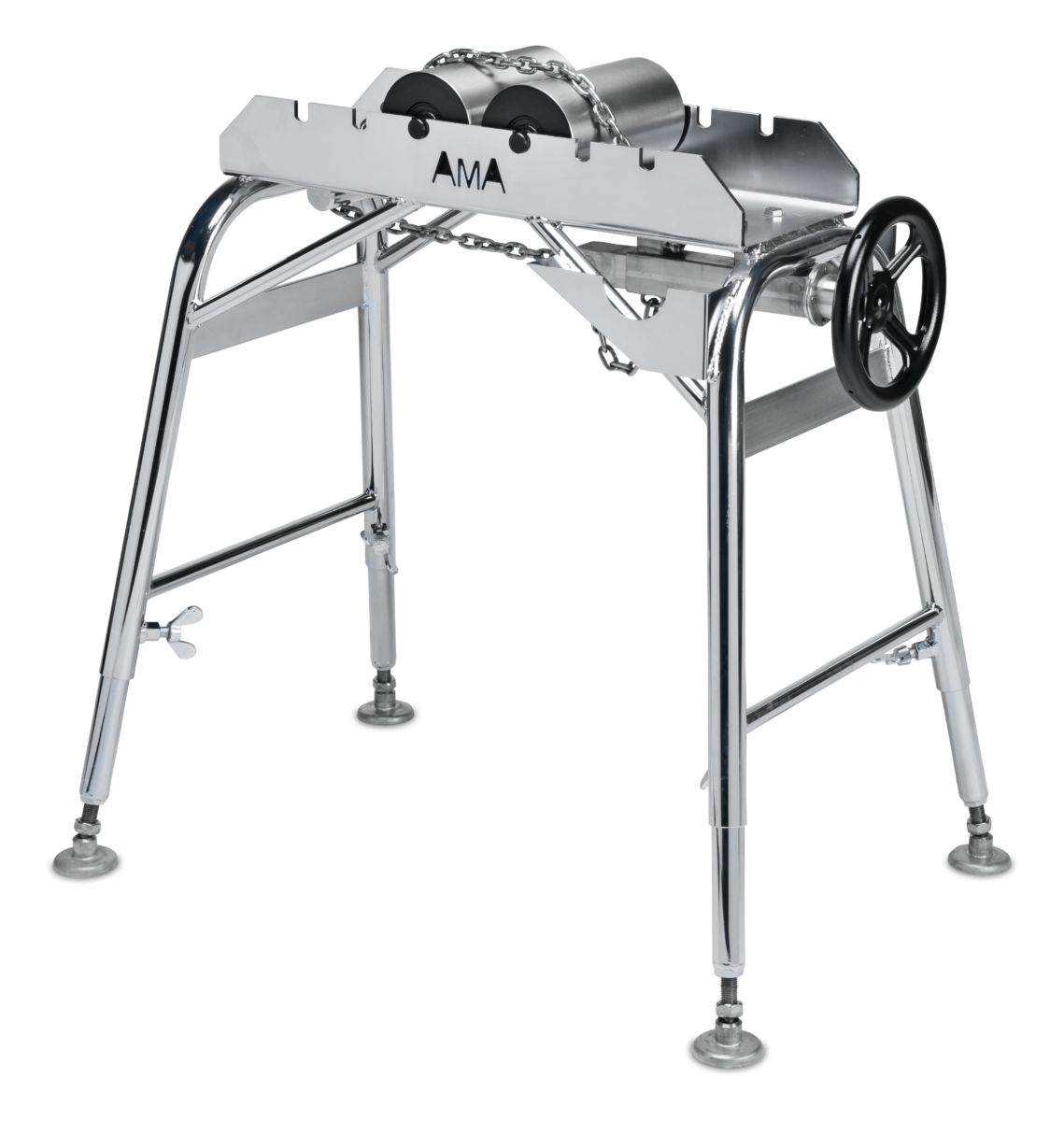
You can secure pipes safely during welding by combining stable mechanical supports, proper alignment tools, and controlled positioning equipment that holds the pipe firmly in place throughout the entire weld cycle. The right combination depends on pipe diameter, weight, and site conditions. Below, we answer the most common questions about pipe securing so you can set up every weld safely and efficiently.
What are the main risks of unsecured pipes during welding?
Unsecured pipes during welding create three immediate hazards:
- The pipe can roll or shift mid-weld, breaking the joint and ruining the seam
- Sudden movement can injure the welder or nearby workers
- Misalignment caused by pipe movement produces defective welds that fail inspection or fail in service
These risks increase with pipe diameter and weight, but even smaller pipes on uneven ground can shift unexpectedly if they are not properly supported.
Even a slight slope or an uneven surface is enough to cause an unsupported pipe to shift. When this happens during tack welding, the joint gap changes and the tack may crack. During full welding passes, pipe movement creates inconsistent penetration and heat distribution, which compromises the integrity of the finished weld.
Beyond weld quality, there is a direct safety concern. A heavy pipe rolling off an improvised support can cause serious crush injuries. Proper pipe welding safety is not optional on professional construction sites — it is a baseline requirement that protects both workers and the finished installation.
What tools are used to hold pipes in position for welding?
The main tools used to hold pipes in position for welding are pipe stands, pipe rollers, centering collars, and rotator systems. Each tool serves a different function: stands provide stable elevation and support, rollers allow controlled rotation, and centering collars lock two pipe ends in precise axial alignment before and during tack welding.
A complete support setup typically includes:
- Adjustable pipe stands that support the pipe at the correct working height and prevent rolling
- Pipe rollers or rotators that allow the pipe to be turned smoothly without repositioning the welder
- Centering collars that clamp around the outside of two pipe ends to hold them in alignment
- Counterweight systems for pipes with elbows or projecting parts that create imbalance
For larger diameters and heavier pipes, a motorized rotator set is the right choice. The AMA HD Rotator Set, for example, combines a motorized rotator with a manual roller table and a sturdy support stand, giving you a complete system for pipes from 100 mm to 1,000 mm in diameter. This kind of pipe welding equipment removes the need for manual repositioning and keeps the welder in one ergonomic position throughout the weld.
How does pipe diameter affect the choice of securing method?
Pipe diameter directly determines the load capacity, support geometry, and type of securing equipment you need.
- Smaller pipes up to around 200 mm can be managed with lightweight stands and simple centering collars
- As diameter increases beyond 300 mm, the mass and surface area of the pipe demand heavier supports, wider roller contact surfaces, and higher-capacity clamping tools
- At diameters above 500 mm, rotation becomes impractical without motorized equipment
Manual rotation of a large-diameter steel pipe is slow, physically demanding, and inconsistent. Motorized pipe rotators solve this by providing controlled, adjustable rotation speed that keeps the weld pool in the optimal position throughout the pass.
Centering collars at larger diameters
Above 600 mm, centering collar systems also change in design. Collars at this size typically come in two parts and require two collar tighteners to apply even clamping force around the full circumference. Using a single tightener on a large collar leaves one side of the joint under-clamped, which allows the gap to shift during tacking.
The practical rule is simple: as diameter increases, every element of your pipe securing setup needs to scale with it. Mixing heavy pipes with undersized supports is one of the most common causes of alignment failures on construction sites.
What is the correct way to align pipes before tack welding?
The correct way to align pipes before tack welding is to support both pipe sections on stands at matching heights, bring the pipe ends together with a consistent root gap, and then apply a centering collar to lock the axial and radial alignment before placing any tacks. Check alignment visually and with a straight edge before striking the arc.
The correct sequence
Placing tack welds before the collar is tightened is a common mistake that permanently locks in misalignment. The correct order is:
- Position both pipe sections on stands and adjust heights so the centerlines match
- Bring the pipe ends together and set the required root gap using spacers or fit-up tools
- Apply the centering collar and tighten it evenly using the appropriate collar tightener
- Verify alignment from two directions before welding
- Place tack welds at equal intervals around the joint while the collar holds position
- Remove the collar only after the tacks are complete and cooled
Pipe alignment tools like stainless steel centering collars reduce fit-up errors to a minimum because they apply consistent clamping force around the full pipe circumference. This is especially useful on construction sites where ground conditions are uneven and pipes tend to shift between positioning and tacking.
When should pipe rollers be used instead of fixed supports?
Pipe rollers should be used instead of fixed supports whenever the pipe needs to rotate during welding or assembly. Fixed supports hold the pipe stationary, which means the welder must move around the pipe to complete the joint. Rollers allow the pipe to turn while the welder stays in one position, which improves weld consistency and reduces fatigue on long runs.
When rollers are the better choice
Rollers are the better choice when:
- The pipe is long and heavy, making welder repositioning slow and tiring
- The weld quality requirement is high and consistent torch angle is important
- You are welding difficult materials like stainless steel where heat input must be controlled carefully
- MIG or MAG welding methods are being used, which benefit most from a stable, consistent position
Fixed supports are more appropriate when the pipe is already installed in a fixed position, when space prevents rotation, or when only short repair welds are needed. In prefabrication and workshop settings, motorized pipe rollers are almost always the more productive choice for pipe welding.
What site conditions make pipe securing more difficult on construction projects?
The site conditions that most commonly make pipe securing more difficult are uneven or soft ground, confined spaces, cold temperatures, and the need to work at height or inside pipe bridges. Each of these factors limits the stability of standard support equipment and requires specific adaptations to maintain safe, accurate pipe positioning.
Ground conditions
On active construction sites, ground conditions are rarely ideal. Soft or compacted gravel surfaces cause pipe stand feet to sink or shift under load, which changes the pipe height and alignment mid-weld. Plywood base plates or ground mats under stand feet are a simple fix that most site teams overlook until a stand sinks during a critical pass.
Confined spaces
When a pipe runs through a pipe bridge or a narrow trench, there is no room to position a rotator alongside it. Pipe bridge stands that attach directly to the bridge beams and lift the pipe onto ball rollers solve this by allowing rotation inside the bridge structure itself, without needing floor space on either side.
Cold temperatures
Cold temperatures affect equipment performance. Rubber drive wheels on pipe rotators have heat resistance limits, and in very cold conditions, lubricants in bearing housings can stiffen and reduce roller smoothness. Checking equipment specifications against working temperature ranges before deployment on winter sites saves time and prevents unexpected failures.
Get in touch
If you are planning a project that involves pipe welding and want to make sure your team has the right securing equipment, contact us and we will help you find the right solution.
You can also find your nearest authorized dealer to get hands-on advice and local availability for AMA pipe welding equipment.