How do pipe rotators improve welding speed?
Posted onPipe rotators eliminate hidden time losses in welding — discover how consistent rotation boosts speed, quality, and efficiency.
Welding speed is rarely just about how fast a welder moves the torch. In pipe welding, the real bottlenecks tend to hide in the preparation, the repositioning, and the constant adjustments that happen between passes. If you work in process industry pipe welding, you already know how much time disappears before the arc even starts. Pipe rotators address several of those bottlenecks directly, and understanding how they do it helps you make smarter decisions about your welding setup and workflow.
This article walks through the mechanics of manual pipe welding time loss, what rotation consistency actually does for weld quality, and how pipe rotators change the practical reality of a welding operation. Whether you are a welder looking for better working conditions, a project manager evaluating efficiency, a purchaser comparing equipment options, or a company owner assessing pipe welding equipment, the goal here is to give you a clear picture of how these tools work and why they matter.
The hidden time costs in manual pipe welding
When you track time on a manual pipe welding job, the arc-on time is often a smaller portion of the total than you might expect. A significant share of the working day goes to repositioning the pipe, adjusting the welder’s stance, stopping to inspect the seam from a different angle, and restarting after each positional change. Each of these interruptions is small on its own, but they accumulate quickly across a full shift or a multi-pipe project.
There is also a physical dimension. Welding in awkward positions is slower and more demanding, which leads to fatigue earlier in the shift. A tired welder makes more corrections, produces more inconsistent passes, and needs more time for grinding and rework. These downstream effects on welding efficiency rarely show up in simple time estimates, but they are very real in practice.
Where the minutes go
- Stopping to rotate or reposition the pipe manually between weld passes
- Adjusting body position to reach overhead or vertical seam sections
- Inspecting difficult-to-see areas of the joint by moving around the pipe
- Grinding out inconsistencies caused by positional welding limitations
- Slowing down travel speed on difficult positional passes to maintain quality
Addressing these time costs does not require changing the welder’s skill level. It requires changing the conditions under which they work. That is exactly where pipe handling tools like rotators come in.
What makes consistent rotation critical for weld quality
Weld quality in pipe joints depends heavily on maintaining consistent travel speed, torch angle, and heat input throughout the pass. When a welder has to stop and reposition, each restart introduces a variable: the heat distribution changes, the torch angle shifts slightly, and the weld pool behavior at the restart point differs from the rest of the pass. These restart points are often where porosity, lack of fusion, or surface irregularities appear.
Consistent pipe rotation solves this by keeping the weld pool in the optimal position — typically at or just past the top of the pipe — while the pipe moves rather than the welder. The torch stays in one ergonomic position throughout the pass. Travel speed stays controlled. Heat input remains even. The result is a seam that behaves more like a machine weld in its consistency, even though a human welder is still doing the work.
The connection between position and penetration
Positional welding — particularly overhead and vertical-up passes — requires the welder to compensate for gravity acting on the weld pool. This compensation typically means reducing travel speed or adjusting parameters, which changes the heat input and can affect penetration.
When the pipe rotates to keep the joint in the flat or slightly inclined position, these compensations become unnecessary. The welder works with gravity rather than against it, which produces more predictable penetration and a more uniform bead profile.
For materials that are sensitive to heat input — such as stainless steel or duplex alloys — this consistency is not just a quality preference. It directly affects the metallurgical outcome of the weld. Controlled, even heat input reduces the risk of sensitization, distortion, and residual stress in the joint.
How pipe rotators change the mechanics of a welding operation
A pipe rotator changes the fundamental dynamic of the job. Instead of the welder moving around the pipe, the pipe moves around the welder. This sounds simple, but the practical implications run throughout the entire operation — from tack welding to final passes to post-weld cleaning.
Here is how rotation supports each stage of the work:
- Tack welding and assembly: Rotation allows the welder to place tacks at consistent intervals without repositioning.
- Root and fill passes: The welder stays in one ergonomic position while the pipe advances at a controlled speed.
- Cleaning and post-weld treatment: The rotating pipe presents the seam continuously to the grinder or brush, reducing the effort and time needed at each step.
Compatibility with welding methods
One practical consideration is that pipe rotators need to work with the welding methods your team actually uses. The AMA Roller pipe rotator is compatible with MIG, MAG, TIG, and covered electrode arc welding, which means it fits into most professional pipe welding workflows without requiring a change in process. This flexibility matters when you work across different materials and specifications on the same site or in the same workshop.
The ability to adjust rotation speed and direction also matters across different pipe sizes and wall thicknesses. A smaller diameter pipe needs a different surface speed than a larger pipe to keep the weld pool in the right position. Adjustable speed control gives the welder that flexibility without interrupting the pass.
Read more about the AMA Roller pipe rotator
Key factors that determine pipe rotator performance
Not all pipe rotators deliver the same results in practice. Several technical factors determine whether a rotator genuinely improves your operation or creates new complications.
Pipe diameter range
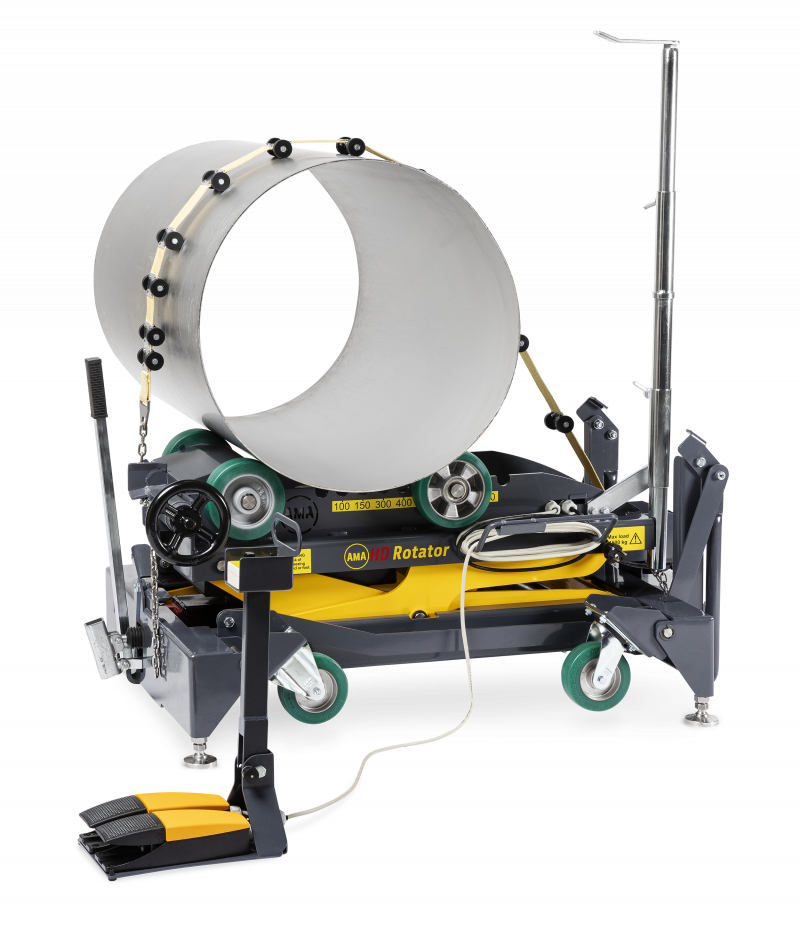
A rotator that handles a wide diameter range gives you flexibility across projects. The AMA Roller Standard and Premium models handle pipes from 30 mm to 508 mm, while the AMA HD Rotator Set handles diameters up to 1,000 mm. AMA products are designed to serve a broad range of pipe sizes — from small-diameter workshop work to larger site installations. Matching the rotator’s range to your typical pipe sizes is the starting point for any equipment decision.
Speed control and adjustability
Stepless speed adjustment lets the welder dial in the exact surface speed needed for the pipe diameter and welding parameters in use. Fixed-speed rotators force the welder to adapt, which reintroduces some of the variability you are trying to eliminate. The ability to control speed with a foot pedal keeps both hands free for welding and makes real-time adjustments easy without breaking concentration.
Load capacity and stability
Heavy pipes or long pipe assemblies put significant demands on the rotator and its support structure. A rotator that flexes or shifts under load introduces vibration and positional inconsistency into the weld. Checking the maximum rotating load and ensuring the support stands are rated appropriately for your pipe weights is important before committing to a setup.
Portability and site adaptability
Workshop environments and construction sites have very different demands. A rotator that is easy to move, quick to set up, and compatible with adjustable pipe stands works in both contexts. For on-site work, wireless control options reduce cable clutter and allow the welder to manage rotation from a comfortable position — even when working on long pipe runs.
Integrating pipe rotators into professional welding workflows
Getting the most from a pipe rotator means thinking about it as part of the complete workflow rather than just an add-on to the welding step. The benefits compound when you use rotation during cutting, tacking, welding, and post-weld treatment — not only during the fill and cap passes.
In a prefabrication workshop
In a prefabrication workshop — where pipe assemblies are prepared before site installation — a pipe rotator combined with proper pipe stands creates a stable, repeatable setup. This reduces variation between welders and between shifts. Newer welders can produce more consistent results because the rotator compensates for some of the positional challenges that separate experienced welders from less experienced ones. This is genuinely useful when you are managing a team with mixed experience levels or training new welders on difficult materials.
On a construction site
On a construction site, the portability and setup speed of the rotator determines how much of the workflow benefit you actually capture. A rotator that takes too long to set up gets left behind when time pressure builds. Choosing equipment that is fast to deploy and easy to move between locations makes the difference between a tool that improves every joint and one that only gets used when conditions are ideal.
In process industry applications
For process industry applications — where pipe materials often include stainless steel, duplex, or other demanding alloys — the combination of consistent rotation, controlled heat input, and ergonomic positioning adds up to fewer rejected welds and less rework. Rework in process piping is expensive in both time and material, so reducing its frequency has a direct and measurable impact on project cost and schedule.
Pipe welding in process industry environments involves too many variables to leave welding speed and quality to chance. Pipe rotators reduce the positional variables that drive inconsistency, fatigue, and rework — and they do it without requiring a change in welding process or a step up in welder skill level.
At Welner, we design and manufacture the AMA Roller and AMA HD Rotator range specifically for professional pipe welding operations, from small workshop setups to heavy on-site work. Our pipe handling tools are built in Finland and used by welding professionals across Europe and far beyond.
If you want to see which AMA products are available through a dealer near you, find your nearest authorized dealer. And if you have questions about which rotator fits your specific pipe sizes, materials, or workflow, get in touch with us directly and we will help you work it out.