How do pipe stands help with stainless steel pipe handling?
Posted onPipe stands prevent contamination and improve alignment — here's what stainless steel pipe handling actually requires.
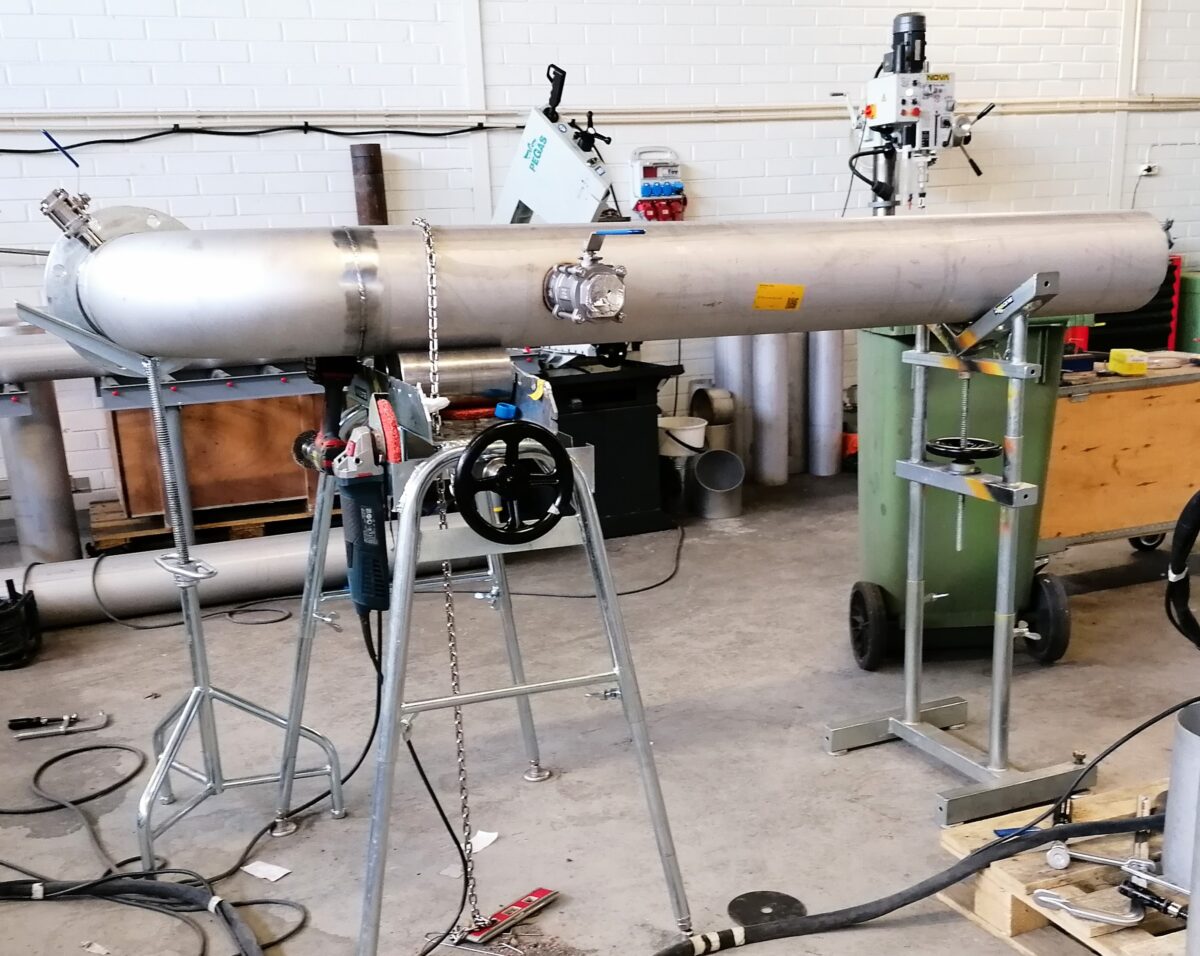
Pipe stands help with stainless steel pipe handling by providing stable, adjustable support that keeps pipes at the right working height and allows controlled rotation during cutting, fitting, and welding. For stainless steel specifically, the right pipe stand also prevents surface contamination and cross-material contact that can compromise weld quality and corrosion resistance.
Stainless steel demands more careful handling than carbon steel or other common pipe materials. Even small mistakes during preparation can affect the finished weld or the long-term performance of the pipe. The sections below walk through the specific challenges, the contamination risks, the stand types available, and how to choose the right support method for your work.
What makes stainless steel pipes harder to handle than other materials?
Stainless steel pipes are harder to handle than carbon steel or mild steel because the material is more sensitive to surface damage, contamination, and heat input. It scratches more easily, reacts to contact with ferrous materials, and requires precise heat management during welding. These properties mean that every stage of handling, from transport to fit-up, needs more attention.
The surface of stainless steel is protected by a thin chromium oxide layer. When that layer is compromised, either by scratching, contamination, or incorrect handling, the pipe becomes vulnerable to rust and corrosion. This is a serious concern in process industries like food production, pharmaceuticals, and chemical processing, where pipe integrity is directly linked to product safety and regulatory compliance.
There are also practical weight and rigidity factors. Stainless steel pipes used in industrial settings are often heavy enough that manual handling without proper support creates alignment errors and increases the risk of injury. Even thinner-walled stainless pipes can deform under their own weight if they are not supported correctly along their length during prefabrication.
How do pipe stands prevent contamination during stainless steel welding prep?
Pipe stands prevent contamination during stainless steel welding prep by keeping the pipe off the floor and away from contact with carbon steel surfaces, tools, and debris. When stainless steel touches ferrous metal, iron particles embed in the surface and cause rust spots, a problem known as cross-contamination. Stands designed for stainless work use stainless steel rollers or ball casters instead of bare steel contact points.
This matters most during the preparation phase, before any welding takes place. A pipe resting on an unprotected steel surface, even briefly, can pick up iron particles that are invisible to the naked eye. These particles only become visible later, as rust spots that are difficult to remove and can indicate deeper surface damage.
Good pipe support stands for stainless steel work feature contact surfaces made from stainless steel or polyurethane. The AMA Pipe Stand Set uses stainless steel rollers on Stand A and stainless steel ball rollers on Stand B, which makes them suitable for stainless and acid-resistant pipe work without introducing contamination risk.
Keeping the pipe elevated and supported also makes it easier to clean the weld area before fitting, apply purge gas correctly, and inspect the joint before welding begins. All of these steps are harder, or simply impractical, when the pipe is lying on the ground.
What types of pipe stands are used for stainless steel pipe work?
The most common types of pipe stands used for stainless steel pipe work are roller stands, ball roller stands, and rotating support stands. Each type serves a different purpose depending on pipe size, weight, and what operation is being performed. The shared requirement for stainless work is that the contact surfaces must not introduce ferrous contamination.
Roller stands
Roller stands use V-shaped or cradle-mounted rollers to support the pipe and allow it to rotate. They are well suited for welding and cutting operations where the pipe needs to turn steadily. On a stand like AMA Stand A, the stainless steel rollers support pipes from 15 mm up to 720 mm in diameter and can carry loads up to 1,500 kg. The AMA Roller pipe rotator can be mounted directly onto Stand A to motorize the rotation, which is useful for longer welds and higher-volume prefabrication work.
Ball roller stands
Ball roller stands use stainless steel ball casters instead of fixed rollers. This allows the pipe to move in any direction, making them useful as auxiliary supports when pushing or positioning long pipe sections. AMA Stand B uses this design and works well alongside Stand A or a pipe rotator when handling longer assemblies. The AMA HD Support and the AMA Pipe Bridge Stand also use stainless steel ball rollers for the same reason.
Rotating support tables
For smaller pipe assemblies and fittings, a rotating gas welding table like the AMA Purge Gas Turntable offers a different kind of support. The stainless steel tabletop rotates on ball bearings and allows the welder to turn short pipe sections by hand while maintaining a gas supply from the center of the table. This is particularly useful for TIG welding of stainless components where purge gas management is part of the process.
How do pipe stands improve alignment accuracy before welding?
Pipe stands improve alignment accuracy before welding by holding the pipe at a consistent, adjustable height so that two pipe ends can be brought together at the correct angle and position without relying on manual support. When both sections sit on stands at the same height, the welder can focus on the joint fit-up rather than compensating for a pipe that is rolling or sagging.
Height adjustment is one of the most useful features here. AMA Stand A adjusts between 840 and 1,100 mm, and Stand B adjusts between 800 and 1,100 mm. Being able to fine-tune the height of each stand independently means you can level out pipes on uneven floors or match the height of a fixed flange or vessel connection.
For the joint itself, centering collars are the tool that directly controls alignment. AMA Centering Collars fit around the outside of two pipe ends and pull them into concentricity before tacking. The pipe stands provide the stable base that makes this possible: if the pipe is moving or unsupported, fitting a centering collar accurately becomes much harder. The stands and the centering collars work together as part of the same preparation workflow.
Pipe stands also reduce the chance of tack weld errors. When a pipe shifts during tacking because it is not properly supported, the weld root gap changes and the finished weld quality suffers. A stable stand eliminates that variable.
Want to see the full AMA pipe stand range?
Explore the AMA Pipe Stand Set and find the right support solution for your stainless steel pipe work.
When should pipe stands be used instead of other pipe support methods?
Pipe stands should be used instead of improvised supports, sawhorses, or floor resting whenever you are working with stainless steel, performing precision fit-up, or doing any operation that requires pipe rotation. They are the right choice for prefabrication workshops and job sites where pipe handling happens repeatedly and quality and speed both matter.
Improvised supports made from timber, carbon steel offcuts, or general workshop furniture introduce contamination risk and offer no height adjustment or rotation capability. They are a practical solution for rough handling of non-sensitive materials, but they are not appropriate for stainless steel preparation work.
Pipe stands are particularly important in the following situations:
- Fitting and tacking stainless steel pipe sections where joint alignment must be precise
- TIG welding of stainless or acid-resistant pipes where purge gas setup requires a stable, elevated pipe
- Cutting pipe with an angle grinder where rotation control improves cut quality and safety
- Handling long pipe assemblies where multiple support points are needed to prevent sagging
- Any work where the pipe surface must remain free of ferrous contamination
For very heavy or large-diameter pipes, motorized rotator systems like the AMA HD Rotator Set extend the same principles to pipes up to 1,000 mm in diameter and loads up to 1,500 kg. The underlying logic is the same: stable, clean support that allows controlled movement and accurate positioning.
In high-volume prefabrication environments, using proper pipe stands consistently also reduces welder fatigue and speeds up the overall workflow. When the pipe is at the right height and can be rotated without stopping to reposition, more of the welder’s attention goes to the weld itself.
Pipe stands are a practical investment for any team doing regular stainless steel pipe work. They protect the material, improve joint quality, and make the whole preparation process faster and safer. At Welner, we design and manufacture the AMA pipe tool range in Finland, with a focus on professional-grade quality for prefabrication workshops and job sites across Northern and Western Europe. Our pipe stands, rotators, centering collars, and purge tools are built to work together as a complete system.
If you want to find the right tools for your team, find your nearest AMA authorized dealer and get hands-on advice for your specific application. You are also welcome to contact us directly if you have questions about which products fit your work best.