Which pipe stand is best for long pipe sections?
Posted onRoller stands outperform fixed supports for long pipe sections — here's how to choose the right setup.
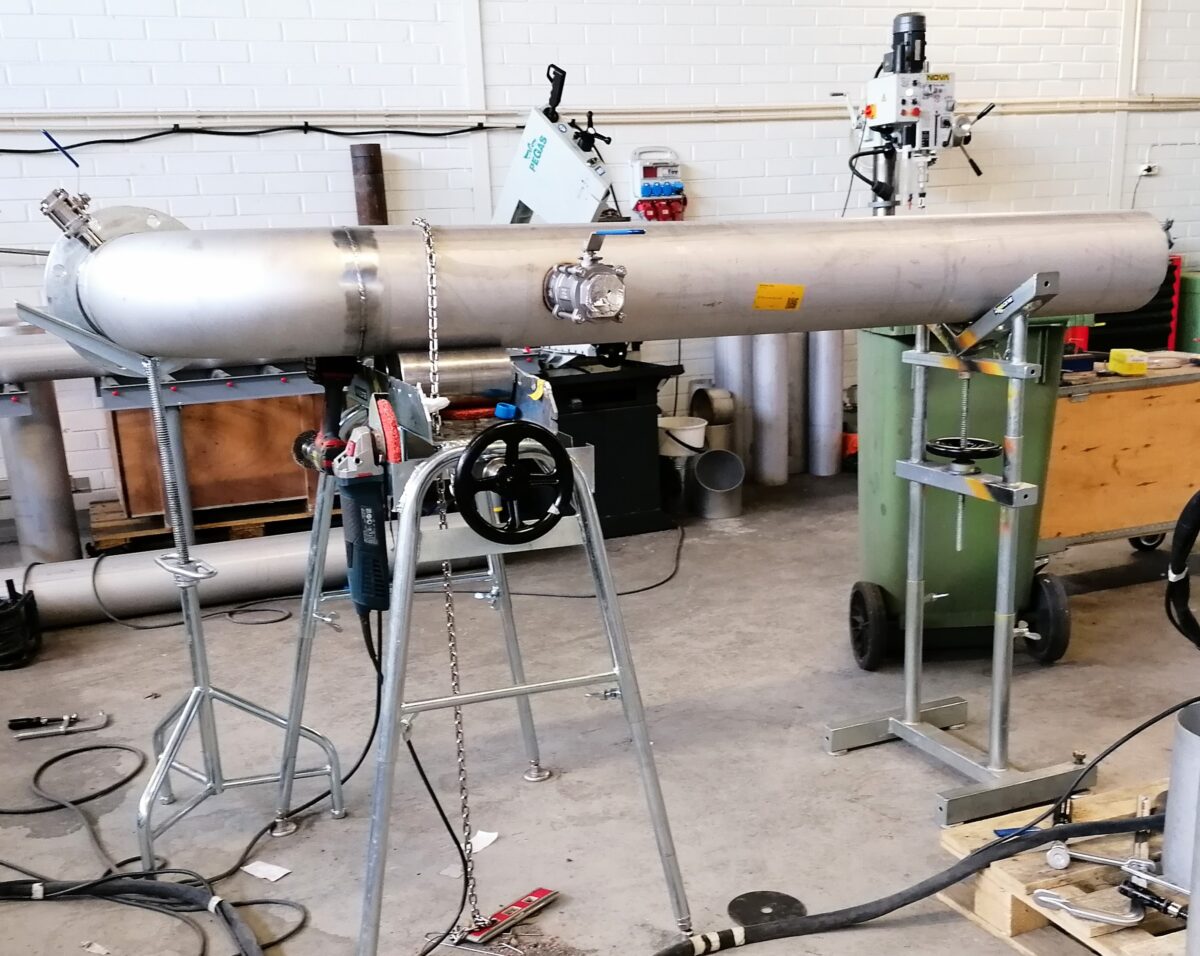
For long pipe sections, a roller-type pipe stand is generally the best choice. Roller stands let the pipe rotate freely during welding and move axially when you need to reposition it, which makes them far more practical than fixed V-block or saddle stands when you are working with several metres of pipe at a time. The sections below walk through every factor that affects your stand selection for long pipe work.
How does pipe length affect stand selection?
Longer pipes need more support points, higher load capacity per stand, and better axial control than shorter sections do. A pipe that is two metres long behaves very differently from one that is six or eight metres: the longer the section, the more it flexes under its own weight, and the greater the risk of misalignment at the weld joint if the stands are not positioned correctly. Pipe length is therefore one of the first things to consider when choosing a pipe stand for welding.
With short sections, a single stand at each end is usually enough. As length increases, you need intermediate support to prevent sagging, which distorts the pipe and puts stress on the joint before you even strike an arc. Long sections also tend to be heavier in total weight, even if the pipe wall is thin, so each stand in your setup must handle a realistic share of that load.
The type of stand matters too. For long sections that need to be rotated during welding, roller stands with ball casters or rotating wheels are the practical choice. Fixed saddle stands or V-blocks are better suited to short, stationary work where rotation is not required.
What types of pipe stands are suitable for long sections?
The most suitable pipe stands for long sections are roller stands and ball-caster support stands. Roller stands allow the pipe to rotate around its own axis during welding, while ball-caster stands let you push and reposition the pipe lengthwise without lifting it. Both types are designed to work together in multi-stand setups, which is exactly what long sections require.
Roller pipe stands
A roller stand holds the pipe on stainless steel or rubber rollers that allow smooth rotation. This is the type you want at the active welding end of the setup. When you pair a roller stand with a pipe rotator, you can weld the entire circumference of the pipe without changing your own position, which improves both quality and speed. The AMA pipe stand set is built around this principle, with the Stand A designed to carry the AMA Roller pipe rotator directly.
Ball-caster support stands
Ball-caster stands, such as the AMA Stand B, act as auxiliary support along the length of the pipe. The stainless steel ball rollers let the pipe move in any direction with minimal friction, so you can rotate or slide it without resistance from the support stands. For very long or heavy sections, a ball-caster support stand every one to two metres keeps the pipe stable and reduces the load on the primary roller stand.
For extremely large or heavy pipes in the 100 to 1,000 mm diameter range, a heavy-duty rotator set with hydraulic height adjustment gives you the load capacity and ergonomic positioning that standard stands cannot provide.
What load capacity do you need for heavy long pipes?
The load capacity you need depends on the total weight of the pipe section divided across the number of stands in your setup, with a safety margin added on top. As a practical rule, never load a stand to its rated maximum. Work at 70 to 80 percent of the stated capacity to account for dynamic forces during rotation, uneven weight distribution, and the added mass of fittings or flanges.
For example, a stand rated at 560 kg is suitable for carrying a share of a pipe assembly that totals around 400 kg on that stand, not the full 560 kg in real working conditions. If your pipe section is particularly long and heavy, use more stands to distribute the weight rather than pushing a single stand to its limit.
Material also plays a role. Stainless steel and heavy-wall carbon steel pipes are significantly denser than thin-wall process piping, so check the actual weight per metre of the pipe you are working with before deciding on stand capacity. Pipe weight tables from the pipe manufacturer are the most reliable reference for this.
How many pipe stands does a long section require?
A long pipe section generally needs one stand for every one to two metres of pipe length, with at least one stand positioned close to each end. The exact number depends on pipe diameter, wall thickness, material, and whether the pipe carries fittings or bends that shift the centre of gravity.
A good starting point is to place your primary roller stand at the welding end, then add support stands working outward. Watch for any visible sag between stands: if the pipe bends noticeably between two support points, add another stand in between. Sag at the joint causes angular misalignment, which affects weld quality and can cause rejection on process piping where tight tolerances apply.
For pipe sections with elbows or projecting parts, the weight distribution becomes uneven. In these cases, a counterweight system can help balance the assembly on the stands rather than adding more stands than the workspace allows.
Want to see how the AMA pipe stand system handles long sections in practice?
Explore the AMA Pipe Stand Set and AMA Roller pipe rotator
What features prevent pipe movement during welding?
The most important features for preventing unwanted pipe movement during welding are fastener chains, chain tighteners, and secure roller locking. A pipe that shifts even a few millimetres mid-weld can cause weld defects, misalignment at the joint, or a safety hazard if the section rolls off the stand entirely.
Fastener chains wrap around the pipe and anchor it to the stand frame. When tightened correctly, they hold the pipe firmly against the rollers and prevent lateral movement. This is particularly important for long sections, where the pipe has more leverage and can tip or roll if something disturbs it during welding.
Beyond chains, the surface of the rollers matters. Standard stainless steel rollers work well for most pipe materials, but rubber wheels provide better grip when the pipe surface is uneven or when you are working with a pipe that has a longitudinal seam. Rubber wheels prevent the pipe from slipping on the rollers during rotation, which keeps the weld position consistent.
Centering collars are another useful addition when you are joining two pipe sections end to end. They align the pipe ends accurately before tacking, which means the joint stays in position throughout the weld rather than drifting as heat builds up.
When should you use adjustable versus fixed-height pipe stands?
Use adjustable-height pipe stands whenever you are working with pipes of different diameters, on uneven floors, or in situations where the working height needs to match the welder’s ergonomic position. Fixed-height stands are only practical in dedicated prefabrication workshops where the same pipe diameter and work height are used consistently.
In most professional pipe welding environments, adjustable stands are the default choice. Process piping projects rarely involve a single pipe size from start to finish, and even within one project, you may move between DN50 fittings and DN300 headers in the same day. A stand with a useful height adjustment range, such as 800 to 1,100 mm, covers the majority of practical working positions without manual shimming or improvised support.
Height adjustment also helps when working on-site rather than in a prefabrication workshop. Site floors are rarely perfectly level, and being able to fine-tune each stand individually keeps the pipe axis horizontal across the full length of the section. A pipe that tilts along its axis is harder to weld consistently and can cause problems when it is installed in the final position.
If you are using a pipe rotator alongside your stands, adjustable height is even more important: the rotator and all support stands need to be at the same working height so the pipe sits level and rotates without binding.
Choosing the right pipe stand for long pipe sections comes down to matching roller type, load capacity, stand count, and height adjustability to the specific pipe you are working with. We design the AMA pipe stand range for professional pipe welding across a wide range of pipe sizes and working environments, from prefabrication workshops to on-site installation. Whether you are a welder looking for equipment that makes the job easier or a project manager specifying tools for your team, the right stand setup saves time and improves weld quality on every joint.
Find your nearest supplier through our authorized dealer network and get the AMA tools that suit your region and project needs. You are also welcome to contact us directly if you have questions about which pipe stand configuration works best for your application.