What equipment helps reduce weld defects?
Posted onDiscover which pipe alignment, handling, and purging tools eliminate weld defects before they start.
The most effective way to reduce weld defects is to control the conditions before welding begins. Proper pipe alignment, clean joint preparation, and stable pipe handling during welding prevent the majority of defects that show up in finished welds. The sections below walk through the specific equipment that makes the biggest difference at each stage of the process.
What causes most weld defects in pipe welding?
Most weld defects in pipe welding come from poor joint preparation and unstable working conditions, not from the welder’s technique alone. Misaligned pipes, uneven bevel angles, surface contamination, and inconsistent positioning during welding are the leading causes of porosity, lack of fusion, and incomplete penetration. Addressing these issues before striking an arc eliminates a large share of defects.
When pipes are not properly aligned at the joint, the root gap becomes uneven. This forces the welder to compensate constantly, which leads to inconsistent heat input and fusion. Similarly, contamination from grease, moisture, or mill scale introduces porosity into the weld pool. Poor shielding gas coverage during the root pass on stainless steel or other sensitive materials causes oxidation on the back side of the weld, which can compromise both appearance and structural integrity.
The common thread across all these causes is preparation. Welding equipment and pipe handling tools that stabilize, align, and protect the joint before and during welding directly address the root causes of defects rather than trying to correct them after the fact.
What pipe alignment tools reduce fit-up errors?
Pipe centering collars are the most direct tool for reducing fit-up errors. They clamp around the outside of two pipe ends to hold them concentric and correctly gapped before tack welding. This eliminates the manual adjustments and guesswork that lead to misalignment, which is one of the most common sources of weld defects in pipe welding.
Our AMA Centering Collars are made from stainless steel and cover a wide range of sizes, from DN65 up to DN1500. Each collar is tightened using a dedicated collar tightener fitted with thrust bearings, which gives you precise, repeatable clamping force without damaging the pipe surface. The result is a joint that sits correctly from the start, so your tack welds hold the right geometry all the way through the root pass and fill passes.
For smaller pipe sizes, the AMA Centering Collar Miniset covers DN65 to DN125 and comes with a mini tightener and a collar holder for your toolbox. Larger jobs use the Basic or Large tightener, with the Large tightener specifically suited to DN600 and above, where thicker walls and greater torsional force are needed. Having the right size collar for the pipe you are working on is what keeps fit-up errors to a minimum across the full range of pipe diameters you encounter on a job.
How does pipe beveling equipment affect weld quality?
Consistent bevel angles give the welder a predictable joint geometry to work with. When the bevel angle and face width are uniform around the full circumference of the pipe, heat input stays consistent, fusion reaches the root reliably, and the finished weld meets the required profile. Irregular bevels force constant adjustments that introduce variability and increase the risk of incomplete fusion and undercut.
Pipe beveling tools, whether portable electric bevelers or angle grinder guides, remove the inconsistency that comes from manual grinding. Freehand grinding of a bevel is difficult to keep uniform, especially on larger diameter pipes or on site where the pipe cannot be repositioned easily. A dedicated beveling tool cuts the same angle every time, regardless of the operator’s experience level.
The bevel also affects gas purging effectiveness. A clean, correctly angled bevel with a consistent root face gives the purge gas a predictable space to fill and protects the back of the weld from oxidation. This matters most when welding stainless steel, duplex, or other materials where back-side oxidation is a quality concern. Combining good beveling practice with a reliable purge system covers both the geometry and the atmosphere of the joint.
What pipe handling tools help maintain weld consistency?
Pipe rotators are the most important pipe handling tools for maintaining weld consistency. By rotating the pipe at a controlled, steady speed, a rotator lets the welder stay in one ergonomic position while the joint moves through the arc. This keeps the welding angle and travel speed constant throughout the pass, which produces a uniform bead profile that closely resembles a mechanized weld.
Pipe rotators for standard pipe diameters
The AMA Roller pipe rotator handles pipes from 30 mm to 508 mm in diameter and mounts on AMA’s A pipe stand. It is foot pedal operated, so you can adjust speed and direction without taking your hands off the torch. The rotation speed is adjustable, which lets you match the travel speed to the welding method and material. This is useful across MIG, MAG, TIG, and covered electrode welding. The AMA Roller Premium version adds Bluetooth wireless control with a range of up to 25 meters, which reduces cables on site and gives you more freedom of movement.
Heavy duty rotation for larger pipes
For pipes up to 1,000 mm in diameter, the AMA HD Rotator Set provides motorized rotation with battery and mains operation and a maximum load of 1,500 kg. The HD Table roller stand supports the pipe alongside the rotator, and the HD Support stand with stainless steel ball casters handles auxiliary support for longer pipes. Height adjustment on both units uses a hydraulic pump, so you can set the working height correctly for the welder without manual lifting.
Pipe stands also play a supporting role in consistency. AMA’s A and B pipe stands hold pipes securely at the right height during prefabrication and on-site assembly. Stable support prevents the pipe from shifting during tack welding, which protects the alignment you achieved with your centering collars.
Which welding accessories help prevent contamination defects?
Purge plugs and gas purging systems are the most effective accessories for preventing contamination defects on the back side of a weld. When welding stainless steel, titanium, or other oxidation-sensitive materials, the inside of the pipe must be filled with inert gas before and during welding to prevent oxidation of the root pass. Without adequate purging, the back bead discolors and loses corrosion resistance.
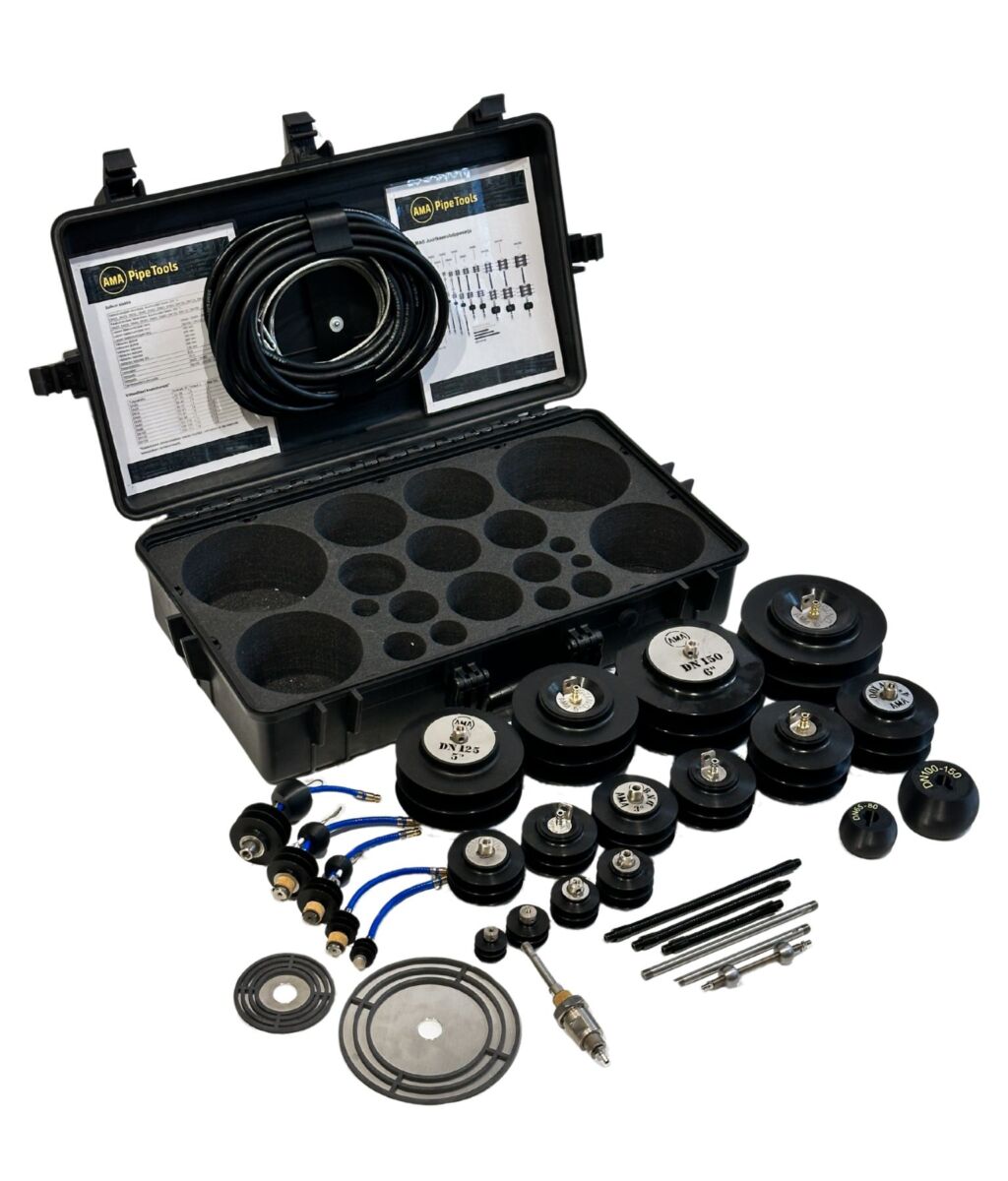
The AMA Pipe Purge Kit uses triple silicone discs to form an airtight seal inside the pipe, isolating the weld zone so inert gas fills only the section that needs protection. This reduces gas consumption significantly compared to purging the entire pipe length. The kit covers pipe sizes from DN20 to DN150 and includes a flange welding kit for DN40 to DN150. Pulling balls make it straightforward to pull the plugs through bends without getting them stuck.
Want to learn more about reducing gas use and purging time?
Read more about the AMA Pipe Purge Kit
Beyond purging, surface cleanliness before welding matters just as much. Grease, oil, moisture, and mill scale all introduce porosity and inclusions. Cleaning the joint area with a dedicated stainless steel brush or appropriate solvent before fitting up removes these contaminants. For stainless steel, using a brush that has not been used on carbon steel prevents iron contamination that causes rust spots in the weld area.
When should welders inspect equipment to avoid defects?
Welders and supervisors should inspect pipe handling and welding preparation equipment at the start of each shift and before beginning a new joint on critical welds. Catching a worn centering collar, a leaking purge plug seal, or a pipe rotator drive wheel that has lost grip before welding starts prevents the defect entirely. Inspection after the fact only confirms a problem that has already affected the weld.
A practical inspection routine covers three points:
- Alignment tools: Check centering collars for deformation, damaged tighteners, or worn contact surfaces that prevent accurate clamping. Replace individual silicone seals on purge plugs as needed, since the AMA Pipe Purge Kit allows each disc to be replaced separately rather than replacing the entire plug assembly.
- Pipe rotators: Check the drive wheel for wear and confirm that the rotation speed is consistent under load. On the AMA Roller Premium, verify the Bluetooth connection between the control unit and the rotator before starting. A rotator that hesitates or varies in speed produces uneven bead width.
- Pipe stands and supports: Confirm that stands are level and that the pipe is sitting securely in the rollers or ball casters before welding. A pipe that shifts during the root pass breaks the alignment you set during fit-up.
On longer projects, a weekly check of all equipment for mechanical wear, loose fasteners, and damaged components keeps everything performing as it should throughout the job. Good equipment condition is what makes consistent, defect-free welding repeatable across an entire team, not just for one welder on one good day.
Reducing weld defects comes down to controlling every step before the arc starts: accurate alignment, clean joint preparation, stable pipe handling, and reliable gas purging. We design and manufacture AMA pipe tools specifically for professional pipe welding in the process industry and prefabrication environments, covering pipe sizes from small-bore tubing up to large-diameter industrial pipe. If you want to see which products are available through a distributor near you, find your nearest authorized dealer. You are also welcome to contact us directly if you have questions about which tools best fit your application.