How do you improve productivity in stainless steel pipe welding?
Posted onCut rework and boost arc time with smarter prep, alignment tools, and heat control strategies for stainless pipe welding.
You can improve productivity in stainless steel pipe welding by reducing the time lost to poor preparation, repositioning, and rework. The biggest gains come from proper pipe alignment before welding, controlled heat input during welding, and using the right tools to keep pipes moving without stopping the arc. These improvements apply whether you work in a prefabrication workshop or on a job site.
The sections below answer the most common questions welders, supervisors, and project managers ask when they want to get more done without cutting corners on quality.
What slows down stainless steel pipe welding the most?
The most common productivity killers in stainless steel pipe welding are poor joint preparation, misaligned pipes, and excessive repositioning. When a welder has to stop, reposition, and restart repeatedly, arc time drops sharply. Stainless steel also reacts badly to heat buildup, which means rushed work often leads to distortion and costly rework.
Other factors that slow things down include:
- Inconsistent root gaps and uneven pipe ends that require grinding before welding can start
- Pipes that are not properly supported, causing movement during tack welding
- Purging delays when inert gas takes too long to displace oxygen from inside the pipe
- Welders having to change body position constantly because the pipe cannot rotate
- Rework caused by oxidation or poor root pass quality on the inside of the pipe
Most of these problems are not welding problems. They are preparation and setup problems. Solving them before the arc starts is where the real productivity gains happen.
How does pipe preparation affect welding speed?
Pipe preparation directly controls how fast welding can proceed. A pipe with clean, square-cut ends and a consistent root gap lets the welder move at a steady pace without stopping to correct the joint. Poor preparation forces interruptions, creates defects, and often requires the weld to be ground out and redone.
Good preparation for stainless steel pipe welding includes:
- Square, clean pipe ends with no burrs or mill scale at the joint area
- Consistent root gap so the root pass penetrates evenly around the full circumference
- Proper tack welds that hold the joint in position without introducing stress or misalignment
- Oxygen purging inside the pipe before the root pass to prevent oxidation and sugaring on the back side of the weld
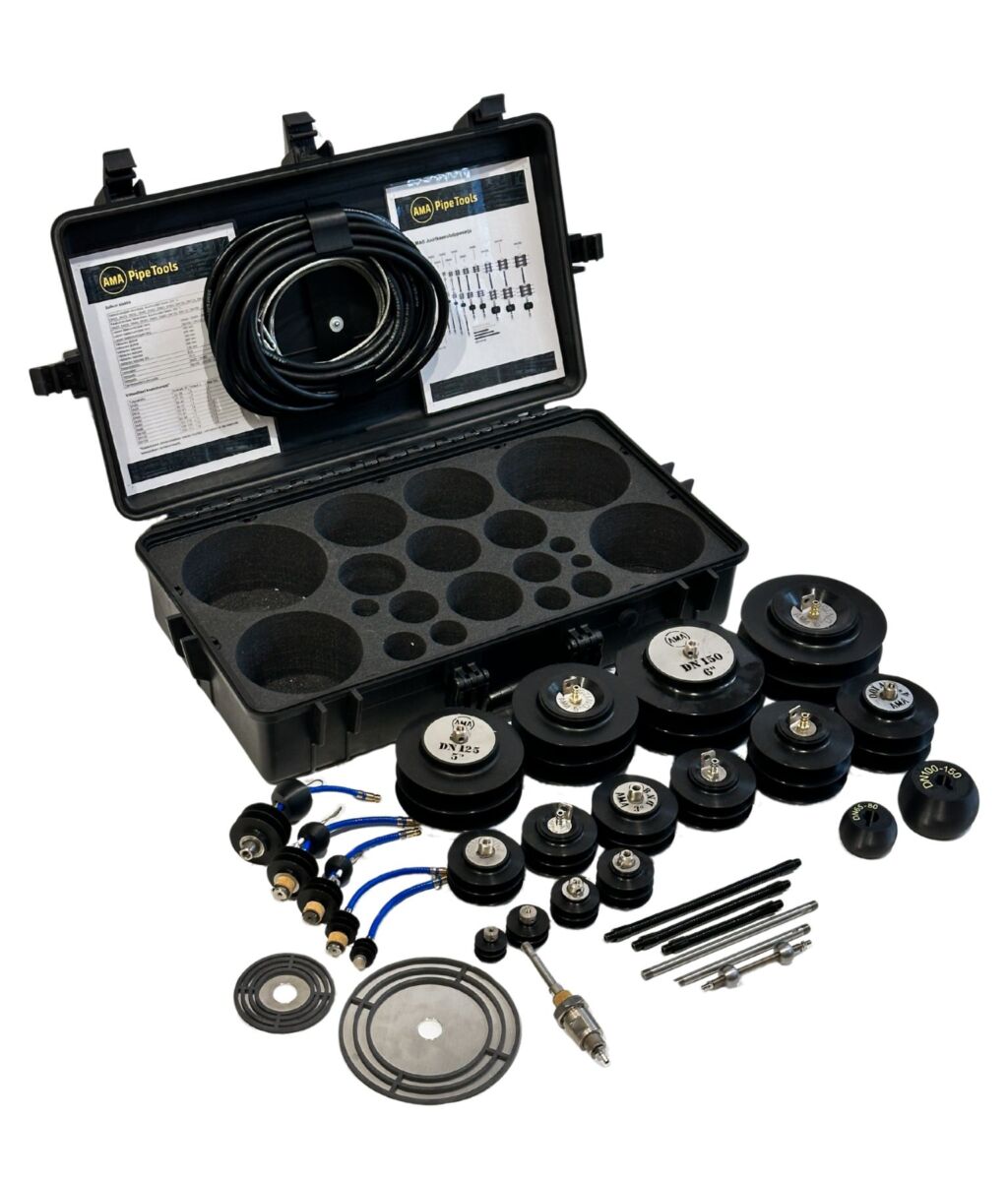
Purging is especially important for stainless steel. If oxygen remains inside the pipe during the root pass, the back of the weld oxidizes and loses corrosion resistance. Fixing this after the fact is time-consuming and sometimes impossible without cutting out the weld entirely. A well-managed purge with the right equipment, such as the AMA Pipe Purge Kit, reduces purging time significantly and uses less inert gas than traditional methods.
What tools help align pipes faster before welding?
Centering collars are the fastest and most accurate way to align pipes before welding. They clamp around the outside of both pipe ends and hold them concentric while tack welds are placed. This removes the need for time-consuming manual adjustment and reduces the risk of misalignment that causes angular distortion or poor fit-up.
Pipe stands are equally important. Adjustable pipe stands support the pipe at the correct height and keep it stable during preparation and tack welding. Without proper support, pipes shift as you work, and any movement after tack welding can crack the tacks or pull the joint out of alignment.
For stainless steel and acid-resistant pipe in particular, the combination of centering collars and well-positioned pipe stands makes a measurable difference in how quickly a joint can be set up and tacked. The AMA Centering Collars, available from DN65 up to DN1500, are designed specifically for this kind of fast, accurate alignment work across a wide range of pipe sizes.
How do you prevent heat distortion in stainless steel pipe welds?
You can prevent heat distortion in stainless steel pipe welds by controlling heat input, using short weld sequences, and allowing adequate interpass cooling. Stainless steel conducts heat poorly compared to carbon steel, which means heat builds up quickly in a localized area and causes the pipe to warp if you do not manage it actively.
Control your heat input
Use the lowest heat input that still gives you a sound weld. Stainless steel does not need high amperage to fuse. High amperage increases distortion risk and can also sensitize the material, reducing corrosion resistance near the weld. TIG welding gives you the most control over heat input and is the preferred method for thin-wall stainless pipe.
Manage interpass temperature
Let the pipe cool between passes. A good rule is to keep interpass temperature below 150 degrees Celsius for austenitic stainless steel. If you weld continuously without checking temperature, heat accumulates and distortion follows. Using a contact thermometer or temperature-indicating sticks takes only a few seconds and prevents expensive rework.
Rotating the pipe so that the welder stays in one ergonomic position also helps with heat control. When a pipe rotator handles the movement, the welder can focus on maintaining consistent travel speed and arc length, which directly reduces irregular heat input and the distortion that comes with it.
When should you use pipe welding positioners or rotators?
You should use a pipe rotator whenever you are welding a pipe that is long enough or heavy enough to make manual repositioning impractical or unsafe. Rotators keep the pipe turning at a controlled speed so the welder works in a fixed, comfortable position rather than moving around the pipe or changing posture repeatedly.
The practical benefits are significant:
- The welder maintains the same position throughout the weld, which improves consistency and reduces fatigue
- Tack welding becomes faster because the pipe rotates to the next position rather than the welder walking around it
- Weld quality improves because travel speed stays steady and the welder can concentrate on the arc
- MIG and MAG welding of pipes becomes practical, which is difficult to achieve without a rotator
The AMA Roller pipe rotator is designed for exactly this kind of work. It handles pipe diameters from 30 mm to 508 mm and is suitable for both prefabrication workshops and on-site use. The Premium version adds Bluetooth wireless control with a range of up to 25 meters, so the welder can adjust rotation speed without leaving the welding position.
Read more about the AMA Roller pipe rotator:
AMA Pipe Purge Kit product page
For larger pipes, the AMA HD Rotator Set handles diameters up to 1,000 mm with battery operation that lasts a full working day, making it practical for heavy industrial pipe work where stopping to recharge or refuel is not an option.
What are the best practices for high-volume stainless pipe welding?
High-volume stainless steel pipe welding requires a systematic approach to setup, tool selection, and workflow. The goal is to minimize non-arc time, which is everything that happens between putting down one weld and starting the next. In most workshops, non-arc time accounts for a large share of the working day.
The practices that make the biggest difference in high-volume environments are:
- Standardize your setup sequence. Use the same steps every time: support the pipe on stands, align with centering collars, purge the inside, tack, and then weld. A consistent sequence reduces errors and speeds up each individual job.
- Use dedicated tools for each phase. Do not improvise alignment or purging. Purpose-built tools like centering collars and purge kits do the job faster and with less variation than makeshift solutions.
- Rotate pipes mechanically. A pipe rotator pays for itself quickly in high-volume environments. The reduction in welder fatigue alone improves output over a full shift, and the improvement in weld consistency reduces rework.
- Control purge gas consumption. Inert gas is a significant cost in stainless pipe welding. A good purge system seals the pipe section being welded rather than flooding the entire pipe, which cuts gas use and shortens purge time.
- Track interpass temperature consistently. In high-volume work, the temptation is to push ahead without waiting. This is where distortion and quality problems accumulate. A simple temperature check between passes protects both the weld and the schedule.
In prefabrication workshops where multiple pipe assemblies move through the same stages, organizing workstations around these practices reduces the time each assembly spends in each station and keeps the overall workflow moving.
At Welner, we design and manufacture pipe handling tools that support exactly this kind of structured, efficient workflow. From pipe stands and centering collars to pipe rotators and purge systems, our AMA product range covers the tools that make a real difference in daily stainless steel pipe welding work. We supply professionals across the Nordic countries and wider Europe, and our products are built in Finland to strict quality standards.
If you want to find the nearest stockist, you can find your local AMA dealer on our website. And if you have a specific question about which tools fit your workflow, we are happy to help. Contact us directly and we will get back to you.