How does wireless control improve welding workflows?
Posted onWireless pipe welding control eliminates costly interruptions — discover how remote rotation transforms workflow efficiency and weld consistency.
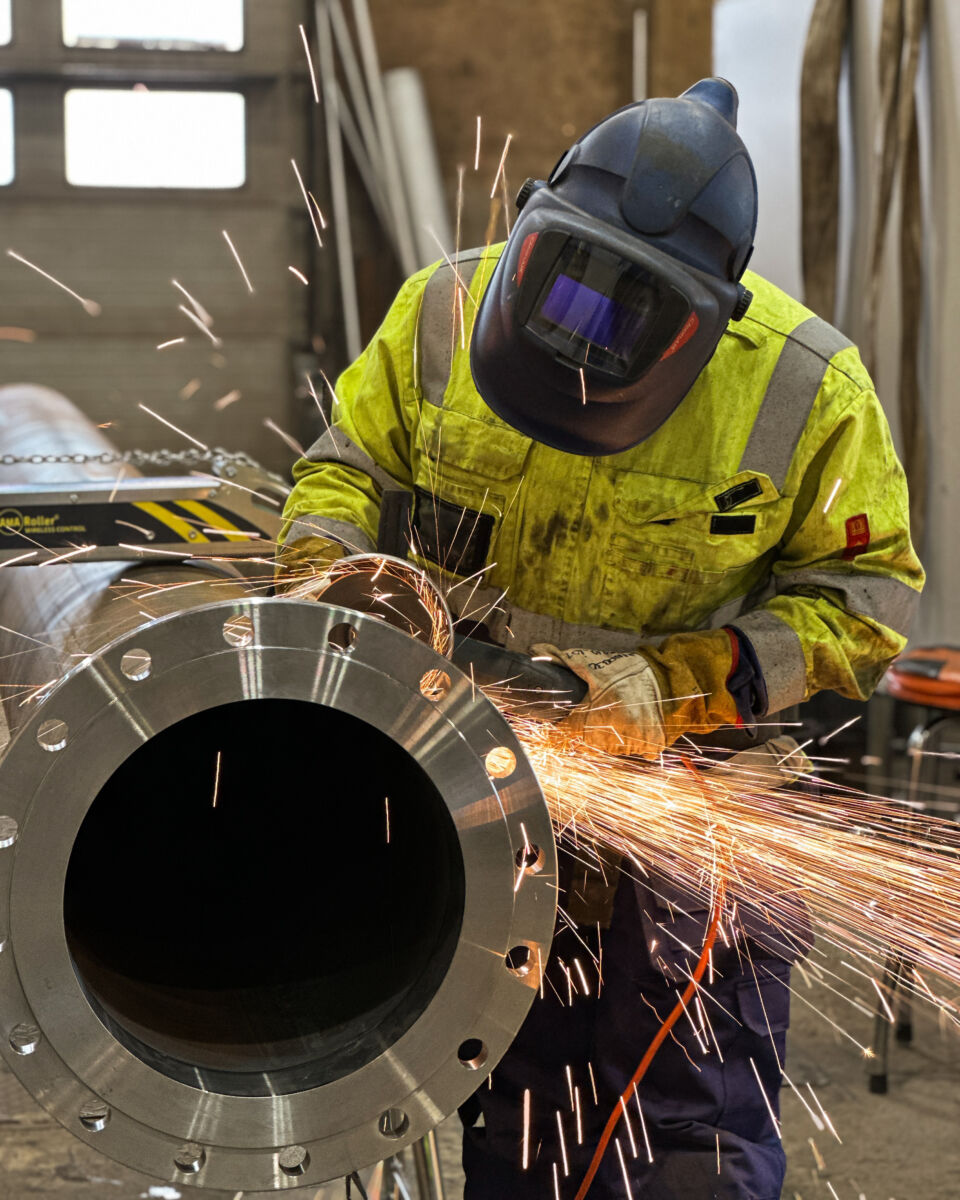
Wireless control improves welding workflows by letting welders adjust pipe rotation speed and direction from a distance, without stopping work to walk back to a control unit. This removes interruptions, reduces repositioning time, and keeps the welder focused on the weld itself. Below, we cover the most common questions about wireless control in pipe welding so you can decide whether it fits your operation.
What tasks in a welding workflow can wireless control automate?
Wireless control in pipe welding primarily automates pipe rotation during welding, tack welding, cutting, and seam cleaning. Instead of manually stopping to adjust the rotator or asking a second person to operate it, you control speed and direction from wherever you are standing, keeping the workflow moving without breaks.
In practice, this covers several stages of a typical pipe welding workflow:
- Tack welding: You can rotate the pipe incrementally to place tack welds evenly around the circumference without repositioning yourself or the pipe stand.
- Full-pass welding: Continuous rotation at a controlled speed means the weld seam comes to you, rather than you moving around the pipe. The result is a more consistent seam that resembles a robot weld in appearance.
- Angle grinder cutting: Controlled rotation makes cutting straighter and faster, since the pipe moves at a steady pace past the tool.
- Back weld cleaning and brushing: Rotating the pipe while brushing stainless steel seams is faster and more thorough when you can adjust speed on the fly.
For long pipes in particular, wireless control makes a real difference. Handling long pipe sections often requires moving between different points along the pipe, and being able to trigger rotation from any position along that length saves significant time. The AMA Roller Premium with wireless control uses Bluetooth to give you control from up to 25 metres away, which covers most prefabrication workshop layouts and on-site setups.
How does wireless control reduce errors in pipe welding?
Wireless control reduces errors in pipe welding by keeping the welder in position and in control of pipe movement at all times. When a welder does not have to stop, walk to a control unit, adjust settings, and walk back, there are fewer interruptions that can cause inconsistent heat input, uneven bead placement, or misaligned tack welds.
Consistency is one of the biggest factors in weld quality. Every time a welder breaks their position, there is a risk of slight changes in torch angle, travel speed, or focus. Wireless remote welding control removes most of those breaks from the process. The welder stays at the joint, maintains their posture and technique, and simply adjusts the rotator speed as needed using a foot pedal or handheld control unit.
Wireless control also reduces the skill gap between welders. When pipe rotation is smooth and controllable from the welding position, less experienced welders can produce results closer to those of senior welders. This is particularly useful for MIG and MAG welding on pipes, where maintaining a consistent travel speed relative to the weld pool is important for penetration and bead profile.
Centering and alignment errors are a separate issue, handled by tools like centering collars, but once the pipe is correctly positioned, wireless rotation control helps maintain that alignment throughout the weld without the physical disturbance of manual adjustment.
What’s the difference between wired and wireless welding control systems?
The main difference between wired and wireless welding control systems is physical freedom. Wired systems tie the operator to the control unit through a cable, which limits movement and adds trip hazards on site. Wireless systems use Bluetooth or radio signals to transmit control commands, so the welder can operate the rotator from any position within range.
Wired control systems
Wired foot pedals and control panels are reliable and straightforward. They do not require charging and are not affected by signal interference. For small, fixed workshop setups where the welder stays in one position, a wired foot pedal works well and adds no complexity. The limitation is the cable itself: it restricts movement, creates a hazard on busy sites, and makes it harder to handle long pipes where the welder may need to move along the pipe length.
Wireless control systems
Wireless systems remove the cable constraint entirely. The welder can move freely around the pipe, operate the rotator from a distance, and avoid cable tangles in areas where multiple tools and hoses are already competing for floor space. The AMA Roller Premium offers both options: you can control rotation via a wireless Bluetooth foot pedal or manually from the control knob on the control unit, giving you flexibility depending on the task. The control unit charges via USB-C, which is a practical detail for sites where charging options need to be simple.
For most professional pipe welding environments in the process industry and prefabrication workshops, wireless control is the more practical choice. Wired systems remain a solid option where the work area is compact and cable management is not a concern.
How does wireless control improve safety on pipe welding sites?
Wireless control improves safety on pipe welding sites by reducing trip hazards, minimising unnecessary movement around heavy rotating equipment, and keeping the welder in a stable, ergonomic position throughout the task. Fewer cables on the floor means fewer accidents, and less movement around the pipe reduces exposure to rotating parts and hot surfaces.
Cable management is a genuine safety issue on active welding sites. When welding hoses, grounding cables, shielding gas lines, and control cables all share the same floor space, the risk of tripping or snagging increases. Removing the rotator control cable from that mix is a straightforward improvement.
Ergonomics also plays a role in safety. When a welder can control pipe rotation from their welding position, they do not need to twist, reach, or move to operate the equipment. Staying in one ergonomic position reduces strain injuries over the course of a shift, which matters particularly for welders working long hours on process industry projects.
For long pipes handled inside pipe bridges or in confined prefabrication areas, the ability to control rotation remotely means the welder does not need to reach past or around the pipe to adjust the rotator. This is a practical safety benefit that is easy to overlook until you have worked in a tight space with a long, heavy pipe section.
What should you look for in a wireless pipe welding control system?
When choosing a wireless pipe welding control system, look for reliable signal range, intuitive controls, compatibility with your pipe sizes and rotator setup, and a robust build suited to workshop and site conditions. The control method, whether foot pedal or handheld, should match how your welders actually work.
Here are the most useful features to evaluate:
- Signal range: Make sure the wireless range covers your actual working distance. A range of 25 metres covers most prefabrication workshop layouts and many on-site configurations.
- Control options: The best systems let you choose between foot pedal control and manual speed adjustment from a control knob. Different tasks suit different control methods, and having both available gives you flexibility.
- Battery life and charging: A control unit that charges via USB-C is practical because the cable type is widely available. Check that the battery capacity is sufficient for a full working day without interruption.
- Pipe diameter compatibility: Confirm that the rotator supports the pipe sizes you work with. The AMA Roller handles pipe diameters from 30 mm to 508 mm, which covers a wide range of process industry pipe sizes.
- Rotation speed range: Adjustable speed matters for different welding methods and materials. A maximum rotation speed of 1.7 m/min gives enough range for MIG, MAG, TIG, and covered electrode welding.
- Portability: If you work across multiple sites or move between workshop areas, a rotator that is easy to move and quick to set up saves setup time on every job.
- Certification: Look for CE-marked equipment that meets relevant safety standards for your region.
It is also worth thinking about the full pipe handling setup, not just the rotator. Pipe stands, centering collars, and auxiliary supports all affect how smoothly the rotation workflow runs. A wireless rotator integrated into a well-organised pipe stand system delivers more benefit than the same rotator used in isolation.
Read more about the AMA Roller pipe rotator to see the full specification and decide which version fits your workflow.
We at Welner Oy design and manufacture pipe handling tools for professional welding teams working in the process industry, prefabrication workshops, and on-site installations. Our AMA product range covers everything from pipe rotators and centering collars to purge kits and pipe stands, all developed and made in Finland to strict quality standards. If you want to improve the efficiency and consistency of your pipe welding workflow, contact us directly and we will help you find the right solution. You can also find your nearest supplier through our authorized dealer network across the Nordic countries and Europe.