How do you achieve accurate pipe fit-up?
Posted onControl alignment, root gap, and joint prep to achieve accurate pipe fit-up and fewer weld repairs.
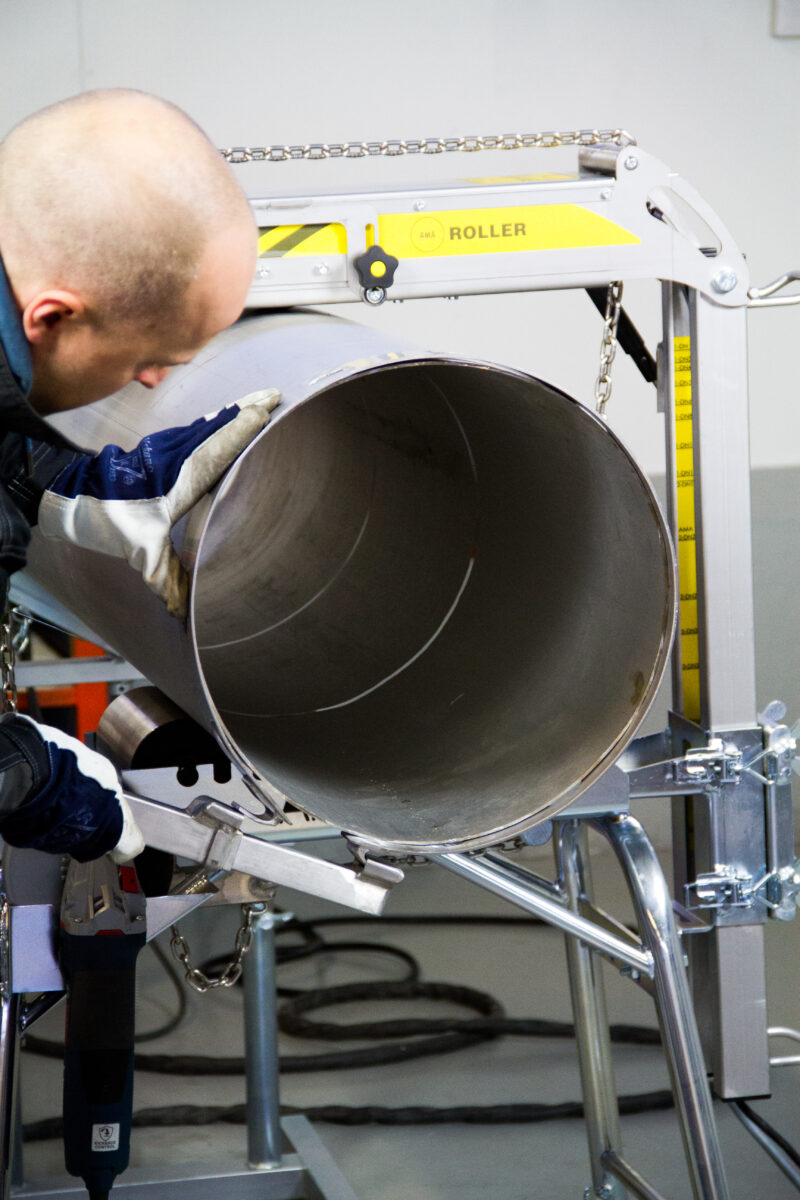
You achieve accurate pipe fit-up by controlling three things: pipe alignment, root gap consistency, and joint preparation quality. When all three are right before welding starts, you get cleaner welds, fewer repairs, and faster work overall. This article walks through the most common questions welders and supervisors ask about pipe fit-up, from the basics to large-diameter challenges.
What factors determine pipe fit-up accuracy?
Pipe fit-up accuracy depends on how well the pipe ends are prepared, how consistently the pipes are supported, and how precisely they are aligned before tack welding. Even small deviations in any of these areas can result in high-low misalignment, uneven root gaps, or joint distortion during welding.
The main factors that affect fit-up quality include:
- End preparation: Pipe ends must be cut square and beveled to the correct angle. Any out-of-square cut creates an uneven gap around the joint.
- Pipe ovality: Pipes are not always perfectly round, especially after transport or storage. Oval pipe ends make it harder to maintain a consistent root gap.
- Support and stability: Pipes that are not properly supported tend to sag or shift during fit-up, which changes the alignment as soon as you let go.
- Centering accuracy: How well the pipe ends are centered relative to each other directly controls the high-low value at the joint.
- Material and wall thickness: Thicker-walled pipes are more rigid and easier to hold in position, while thin-wall pipes are more sensitive to clamping force and handling.
In pipe spool assembly and prefabrication work, these factors multiply across multiple joints. Getting each one right from the start saves significant rework time later.
What are the most common pipe fit-up mistakes?
The most common pipe fit-up mistakes are poor end preparation, inconsistent root gaps, and inadequate support during alignment. High-low misalignment is also a frequent problem, especially when working with pipes from different batches that have slightly different outer diameters.
Here is a closer look at the mistakes that cause the most problems on the job:
- Skipping proper end preparation: Rushing the cutting and beveling step leads to uneven joint faces that are impossible to align correctly.
- Eyeballing the root gap: Estimating the gap by eye instead of measuring it leads to inconsistent penetration and weld quality across the joint.
- Tack welding too early: Locking the joint in place before checking alignment means any error is built into the weld.
- Using makeshift supports: Improvised pipe supports shift under load, causing the pipe to move during fit-up and tack welding.
- Ignoring pipe rotation: Not rotating the pipe to check alignment from multiple positions means you might only see one side of a misalignment problem.
- Forcing pipes into position: Applying too much clamping force to compensate for poor fit can introduce stress into the joint that affects weld integrity.
Many of these mistakes come down to time pressure. When supervisors and welders understand the cost of rework versus the time spent on proper fit-up, the case for doing it right the first time becomes straightforward.
How do pipe fit-up tools improve alignment precision?
Pipe fit-up tools improve alignment precision by holding pipes in a fixed, repeatable position so that alignment does not rely on manual judgment or improvised methods. External alignment tools, pipe stands, and centering collars each address a different part of the fit-up process, and together they significantly reduce the chance of human error.
Centering collars are one of the most direct ways to improve pipe alignment accuracy. The AMA Centering Collars are stainless steel collars that fit around the outside of two pipe ends and center them relative to each other before tack welding. They are available for pipe sizes from DN65 up to DN1500, which covers everything from small process pipes to large-diameter industrial pipework.
Pipe stands also play an important role. Adjustable, stable stands keep the pipe at the right height and prevent sagging or shifting during fit-up. When stands are combined with a pipe rotator, you can check and adjust alignment from any position around the pipe without moving the pipe manually.
The overall benefit of using proper fit-up tools is consistency. Whether you are working on a single spool in a prefabrication workshop or assembling multiple joints on site, the right tools help every welder achieve the same standard of fit-up quality regardless of individual skill level.
Read more about centering collars and find the right size for your application:
AMA Centering Collar Set
What is the correct root gap for pipe welding?
The correct root gap for pipe welding depends on the welding process, pipe material, wall thickness, and the applicable welding procedure specification (WPS). For most common processes such as TIG and MIG/MAG, a root gap of 2 to 4 mm is typical, but you should always follow the WPS for the specific job.
Root gap consistency matters as much as the gap value itself. A gap that varies around the joint causes uneven penetration, which can lead to lack of fusion on the narrow side or burn-through on the wider side. This is why measuring the root gap at multiple points around the pipe before tack welding is good practice, not optional.
A few factors that influence root gap selection:
- Welding process: TIG root passes on stainless steel often require a tighter, more controlled gap than MIG/MAG processes.
- Material type: Some materials, such as duplex stainless steel, have specific requirements defined in the WPS that must be followed precisely.
- Joint configuration: Butt joints, socket welds, and flange connections each have different gap requirements.
- Pipe wall thickness: Thicker walls generally allow for slightly more variation, but precision is always preferred.
Using proper fit-up tools, including centering collars and tack welding aids, helps you set and hold the correct root gap consistently around the full circumference of the joint.
How do you check pipe fit-up quality before welding?
You check pipe fit-up quality before welding by verifying four things: pipe alignment (high-low), root gap consistency, joint cleanliness, and tack weld placement. Each check should be done before any tack weld is placed and confirmed again before the root pass begins.
Checking alignment and high-low
Use a straight edge or weld gauge to check the high-low value at the joint. High-low misalignment occurs when the outer surfaces of the two pipe ends are not flush. Most welding standards specify a maximum allowable high-low, and exceeding it is a cause for rejection. Check this at a minimum of four points around the pipe circumference.
Checking root gap and joint preparation
Use a calibrated gap gauge or feeler gauge to measure the root gap at multiple points around the joint. The gap should be within the tolerance specified in your WPS. Also inspect the bevel angle, bevel face condition, and the cleanliness of the joint area. Any grease, moisture, rust, or mill scale in the weld zone should be removed before welding begins.
Once tack welds are in place, check that they are evenly spaced, free from cracks, and do not introduce any new misalignment. A tack weld that pulls the pipe out of alignment is worse than no tack weld at all. Rotate the pipe using a pipe rotator to inspect all positions without having to reposition yourself around the joint.
Which pipe fit-up method works best for large-diameter pipes?
For large-diameter pipes, external alignment with centering collars combined with a heavy-duty pipe rotator gives the best fit-up results. This approach lets you center the pipe ends precisely, set a consistent root gap, and rotate the pipe to check and adjust alignment from any position without manual lifting or repositioning.
Large-diameter pipes bring specific challenges. Their weight makes manual adjustment difficult, and their size means any misalignment is more visible and harder to correct after tack welding. Using the right tools from the start is the most practical way to manage these challenges.
The AMA Centering Collars are available up to DN1500, which covers a wide range of large-diameter applications in the process industry pipework. For rotating large pipes during fit-up and welding, the AMA HD Rotator Set handles pipe diameters from 100 to 1,000 mm and supports loads up to 1,500 kg, making it a practical option for heavy pipe spool assembly in both workshop and site environments.
For large-diameter work where the welder needs to move freely around the pipe or work at a distance, the AMA Roller Premium with wireless control offers Bluetooth foot pedal operation up to 25 meters from the rotator, which removes the need to walk back to the control unit between passes.
The general principle for large-diameter fit-up is the same as for any pipe size: support the pipe properly, center the ends accurately, set the root gap consistently, and check alignment before committing to tack welds. The tools just need to be scaled to match the pipe dimensions and weight.
Accurate pipe fit-up is a combination of good preparation, the right tools, and a consistent process. We design and manufacture AMA pipe handling tools specifically for professionals who need reliable, repeatable results in pipe welding and prefabrication, from small-bore stainless steel work to large-diameter industrial pipework. If you want to see which AMA products are available through a distributor near you, find your local authorized dealer. And if you have questions about which tools fit your application, contact us directly and we will help you find the right solution.