How do professional welders achieve consistent root welds?
Posted onDiscover how joint preparation, fit-up accuracy, and purging technique determine root weld consistency in professional pipe welding.
Professional welders achieve consistent root welds by combining precise joint preparation, correct fit-up, controlled welding technique, and proper purging. The root pass is the most demanding part of any pipe weld because it sets the foundation for every subsequent layer. Get it wrong, and no amount of filler passes will fix the structural integrity underneath.
This article walks through the key questions welders and supervisors ask about root pass welding, from fit-up accuracy to defect prevention and quality verification.
What factors most affect root weld consistency?
Root weld consistency depends on four main factors: joint geometry, fit-up accuracy, material cleanliness, and the welder’s technique. When any one of these is off, the root pass suffers. In pipe welding, even small deviations in gap width or pipe alignment can cause incomplete fusion, burn-through, or porosity that runs the full length of the joint.
Material type also plays a significant role. Stainless steel and other alloys respond differently to heat input than carbon steel, which means the welder must adjust travel speed, amperage, and shielding gas accordingly. Inconsistent heat input is one of the most common reasons root welds fail quality inspection.
Finally, the working environment matters. Wind, humidity, and poor lighting all affect the welder’s ability to maintain a stable arc and monitor the weld pool. On-site conditions are harder to control than workshop prefabrication, which is one reason why experienced teams do as much preparation as possible before pipes reach the field.
How does joint preparation influence the root pass?
Joint preparation directly controls the root pass outcome. The bevel angle, root face, and root gap must all fall within the tolerances specified by the welding procedure. If the root gap is too wide, burn-through becomes likely. If it is too narrow, the welder cannot achieve full penetration, leaving a cold lap or incomplete fusion at the root.
Pipe ends must be cut cleanly and squarely. Oval or uneven pipe ends make it nearly impossible to hold a consistent gap around the full circumference. Grinding, machining, or using a pipe beveling tool gives the welder a predictable surface to work with.
Cleanliness is equally important. Oil, moisture, mill scale, and oxide layers all introduce hydrogen and contaminants into the weld pool. These cause porosity and cracking, especially in the root where the weld cross-section is thinnest and most vulnerable. Cleaning the pipe ends thoroughly and keeping them clean until welding begins is a non-negotiable step in professional pipe welding.
What welding technique is used for the root pass in pipe welding?
The most widely used technique for root pass welding in pipes is TIG (GTAW), particularly for stainless steel, chrome-moly, and other high-integrity applications. TIG gives the welder precise control over heat input and weld pool shape, which is important when welding through a narrow root gap with limited access. For carbon steel pipes in less critical applications, cellulosic electrodes with SMAW are common, especially on site.
Regardless of the process, the welder typically uses a keyhole technique on open-root joints. The arc penetrates through the root gap, forming a small keyhole at the leading edge of the weld pool. The welder then moves forward steadily, allowing the pool to close behind the keyhole and fuse both pipe walls from the inside out.
Travel speed and arc length are the two variables that most affect root pass quality during welding. Moving too fast leaves lack of fusion; moving too slowly causes excessive heat build-up and burn-through. Maintaining a short, stable arc length keeps the weld pool under control and reduces spatter and oxidation.
What tools do professional welders use to ensure fit-up accuracy?
Professional welders rely on pipe alignment tools, centering collars, pipe stands, and pipe rotators to achieve accurate fit-up before the root pass begins. Accurate fit-up means the pipe ends are concentric, the root gap is even, and the joint is held in position without relying on the welder to manually support the pipe during tacking.
Alignment and centering tools
Centering collars are one of the most effective tools for achieving accurate pipe alignment quickly. They clamp around the outside of the pipe joint and pull both pipe ends into concentricity, eliminating high-low misalignment. This is especially useful for thin-wall stainless steel and acid-resistant pipes where even small offsets cause visible weld defects. AMA Centering Collars are available in sizes from DN65 to DN1500, covering the full range of pipe diameters used in process industry applications.
Pipe stands and rotators
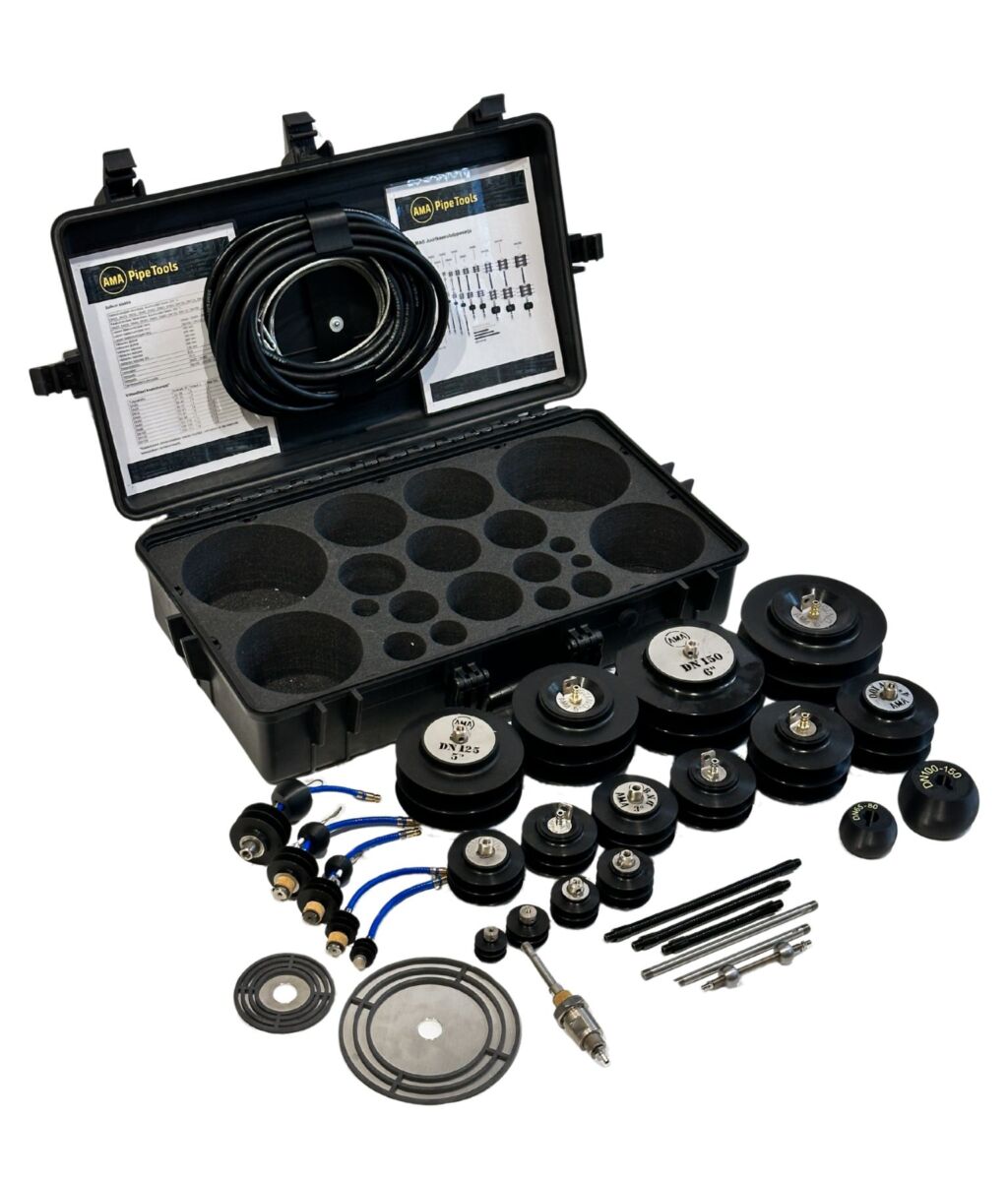
Stable pipe support during tacking and welding is just as important as alignment. Pipe stands hold the pipe at a consistent working height, reducing fatigue and helping the welder maintain a steady position. For shops doing volume prefabrication work, a pipe rotator takes this a step further by rotating the pipe at a controlled speed so the welder can stay in one ergonomic position throughout the weld. The AMA Pipe Purge Kit is another tool that supports consistent root welds in stainless and alloy pipe applications by reducing purge time and protecting the back of the root from oxidation.
Want to see how the AMA Roller pipe rotator improves root weld quality in prefabrication?Read more about the AMA Pipe Purge Kit here.
What causes root weld defects and how are they prevented?
The most common root weld defects are incomplete penetration, lack of fusion, porosity, burn-through, and oxidation on the inside of the pipe. Each has a specific cause and a specific prevention strategy. Identifying the root cause of a defect is the first step toward eliminating it consistently.
- Incomplete penetration is caused by a root gap that is too small, insufficient heat input, or moving too fast. Prevention: verify gap dimensions before tacking and follow the approved welding procedure parameters.
- Lack of fusion occurs when the arc does not fully melt both pipe walls at the root. Prevention: adjust travel angle and ensure the arc is directed into the joint, not just onto the surface.
- Porosity results from contamination, moisture, or inadequate shielding gas coverage. Prevention: clean pipe ends thoroughly, use dry consumables, and verify gas flow rates before starting.
- Burn-through happens when heat input is too high relative to wall thickness. Prevention: reduce amperage, increase travel speed, and use pulse settings where available.
- Internal oxidation (sugaring) on stainless steel occurs when the back of the root weld is exposed to oxygen during welding. Prevention: purge the inside of the pipe with inert gas and maintain purge pressure throughout the root pass. A well-designed purge system, such as the AMA Pipe Purge Kit, reduces both purge time and gas consumption while forming an airtight seal.
How do welders verify root weld quality before continuing?
Welders verify root weld quality through visual inspection, followed by non-destructive testing (NDT) methods specified in the project’s welding procedure specification (WPS). Visual inspection is always the first check. The welder examines the internal root bead profile where accessible, looking for concavity, burn-through, excess penetration, or discoloration that indicates oxidation.
On stainless steel and high-alloy pipe welds, internal discoloration (straw, blue, or grey tones) is a direct sign that the purge was inadequate. A clean silver root bead indicates the weld was properly protected. Some projects require a borescope inspection of the internal root bead before filler passes begin, particularly in pharmaceutical, food processing, and high-purity process piping applications.
For structural and pressure-bearing pipe systems, radiographic testing (RT) or ultrasonic testing (UT) of the root area is common after the weld is complete. These methods detect internal defects that visual inspection cannot catch. Identifying root defects before filler passes are deposited saves significant rework time, which is why many experienced welding supervisors insist on a visual check of every root pass before the welder continues.
Consistent root welds come down to preparation, the right tools, and disciplined technique. When joint fit-up is accurate, the pipe is properly purged, and the welder follows a proven procedure, the root pass becomes repeatable rather than a source of uncertainty. At Welner, we design and manufacture pipe handling tools that help welding professionals get that preparation right, from centering collars and pipe stands to purge kits and pipe rotators, covering all pipe sizes used in process industry work. Find the nearest stockist or dealer in your region on our authorized dealers page, or contact us directly if you have questions about which tools fit your application.