Why do professional welders use centering collars?
Posted onMisaligned pipes cause costly weld defects — discover how centering collars solve this with precision every time.
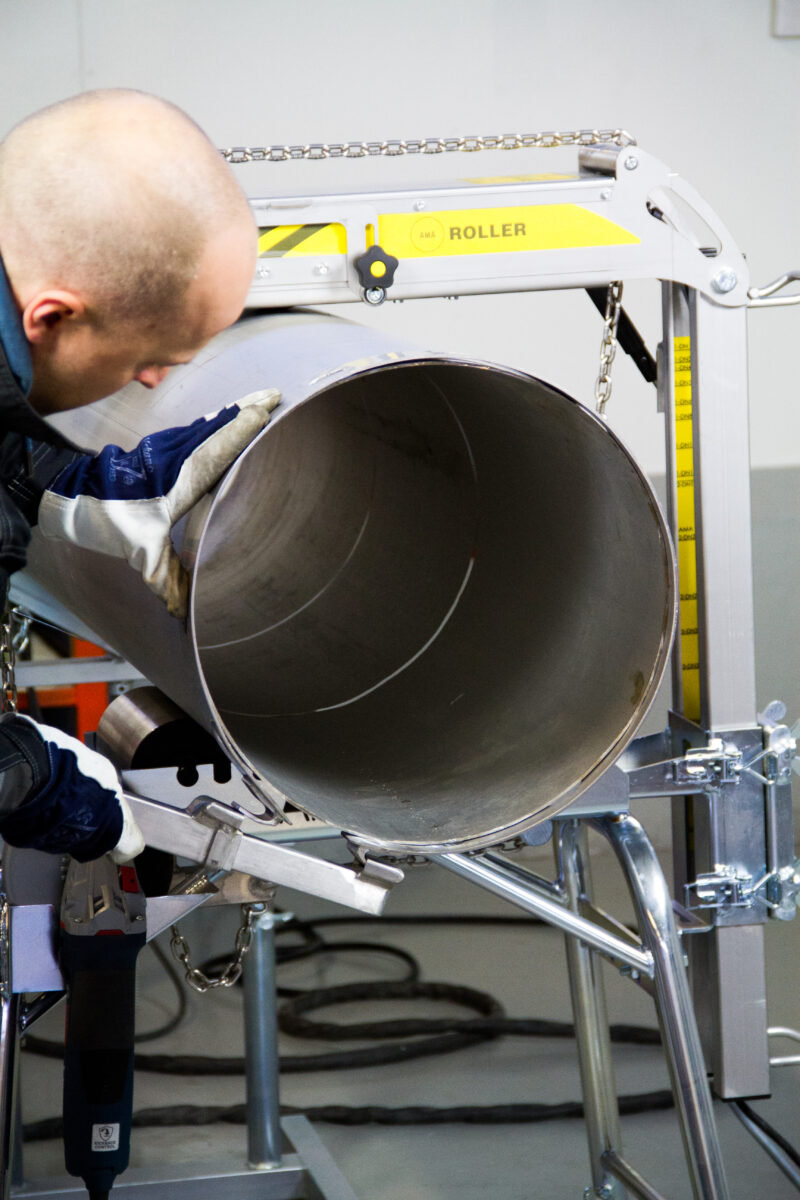
Professional welders use centering collars to hold two pipe ends in precise alignment before and during welding. Without accurate alignment, even a small offset between pipe ends creates a weak joint, uneven root gaps, and weld defects that are costly to repair. This article covers how centering collars work, when to use them, and what to look for when choosing one.
What do centering collars actually do during pipe welding?
A centering collar is an external alignment tool that wraps around the outside of two pipe ends to hold them concentric and flush during pipe fit-up and tack welding. It prevents the pipes from shifting out of position before the weld is strong enough to hold them in place on its own.
In practice, you slide the collar over the joint, tighten it with a collar tightener, and the collar holds both pipe ends in the same plane with a consistent root gap. This gives you a stable, repeatable starting point for every weld.
The collar does not stay on during the full weld pass. You tack weld the joint first, then remove the collar and complete the weld. The key benefit is that the tack welds are made with the pipes held in their correct position, so the final weld starts right.
For pipe spool assembly in prefabrication workshops, centering collars are especially useful. When you are assembling multiple pipe sections into a spool, keeping each joint aligned adds up quickly. One misaligned joint early in the assembly can throw off the entire spool geometry.
How do centering collars improve weld quality?
Centering collars improve weld quality by eliminating two of the most common fit-up problems: high-low (where one pipe sits higher than the other at the joint) and uneven root gaps. Both problems directly affect how the root pass penetrates and fuses, which determines the structural integrity of the finished weld.
When pipes are misaligned, the welder has to compensate manually during welding, which increases the risk of lack of fusion, burn-through, and inconsistent penetration. A collar removes that variable by keeping the joint geometry correct from the start.
There are several specific quality improvements you get from using a centering collar:
- Consistent root gap: The collar holds the gap between pipe ends uniform around the full circumference, which gives the root pass the same conditions all the way around.
- No high-low offset: Both pipe walls sit flush, so the welder does not need to bridge a step between pipe ends.
- Repeatable results: Every joint is set up the same way, which reduces variation between welders and between shifts.
- Fewer repairs: Correct fit-up from the start means fewer weld defects that require grinding out and re-welding.
In process industry pipe welding, where joints often need to meet strict inspection standards, reducing fit-up errors at the start is far more efficient than correcting defects after the fact.
What types of pipes and diameters are centering collars used for?
Centering collars are used across a wide range of pipe types and sizes, from small-bore process piping to large-diameter industrial pipe. They work on stainless steel, acid-resistant, and carbon steel pipes, and they are suitable for both prefabrication workshops and on-site installation.
The AMA centering collars cover DN65 through DN1500 in DN-dimensioned sizes, and NS100 through NS1500 in NS-dimensioned sizes. Collar sizes DN350 and larger are compatible with both DN and NS dimensions, which makes them flexible for mixed-specification projects.
This range covers the pipe sizes most commonly found in process industry applications, including:
- Utility and service piping in smaller diameters (DN65 to DN150)
- Process and instrumentation lines in mid-range sizes (DN150 to DN500)
- Large-bore structural and industrial pipe (DN500 and above)
The collar material matters too. Stainless steel collars are suitable for use with acid-resistant and stainless steel pipes, where contamination from carbon steel tools is a concern. Using the right collar material protects the pipe surface and avoids introducing contamination into the joint area before welding.
For very large collars (DN600 and above), two-part collars are used. These require two collar tighteners to achieve even clamping force around the full circumference of the pipe.
How do centering collars compare to other pipe alignment methods?
Centering collars are faster and more precise than most manual alignment methods, and they require no internal access to the pipe. Compared to internal clamps, chain clamps, or manual tacking by eye, a centering collar gives you reliable external alignment without specialised equipment or skilled judgment to get the fit-up right.
Centering collars vs. manual alignment
Manual alignment means a welder holds or props the pipes in position while a helper tacks them. This works on simple joints in accessible locations, but it introduces human error into the fit-up. High-low offsets and uneven root gaps are common results. A centering collar removes the guesswork and holds the joint consistently without needing a second person.
Centering collars vs. chain clamps
Chain clamps pull pipe ends together but do not always ensure concentricity. They are better at closing gaps than at correcting angular or radial misalignment. Centering collars address both gap control and concentricity at the same time, which makes them more suitable for joints where fit-up quality is a priority.
For most pipe welding in process industry settings, centering collars offer the best balance of speed, accuracy, and ease of use among external alignment tools.
When should a welder use a centering collar versus an internal clamp?
Use a centering collar when you need fast external alignment and do not have access to the inside of the pipe. Use an internal clamp when internal access is available and the pipe diameter is large enough to work inside, or when the application specifically requires internal clamping for purge gas control during TIG root welding.
Internal clamps provide very accurate alignment and can also act as a backing for the root pass, which is useful in some TIG welding applications. However, they require the pipe to be open at one end and large enough to insert the clamp. They also take more time to set up and remove.
Centering collars are the practical choice in most field and prefabrication situations because:
- They work on any pipe that is accessible from the outside
- Setup and removal are quick, which matters in high-volume pipe spool assembly
- They do not require the pipe to be open at both ends
- They are suitable for smaller pipe diameters where internal clamping is not practical
If you are welding a closed spool where one end is already capped or connected, a centering collar is often the only realistic option for external alignment. For open-ended large-bore pipe where internal access is straightforward, an internal clamp may give slightly better root gap control, but the difference is small when a quality centering collar is used correctly.
What features should professionals look for in a centering collar?
The most important features in a centering collar are material quality, tightening mechanism, size range, and ease of use. A collar that is difficult to tighten evenly or that deforms under load will not hold the pipe in accurate alignment, which defeats the purpose of using one.
Here is what to check when evaluating centering collars:
- Material: Stainless steel collars are suitable for use on stainless and acid-resistant pipe without risk of surface contamination. This matters in process industry applications where material traceability and surface cleanliness are requirements.
- Collar tightener quality: The tightener should have thrust bearings so that tightening force is applied evenly without twisting or distorting the collar. A collar tightener without thrust bearings is harder to use and gives less consistent clamping.
- Size compatibility: Check that the collar covers the DN or NS dimensions you work with. If you work across a range of pipe sizes, a set that covers multiple sizes is more practical than buying individual collars.
- Two-part design for large diameters: For DN600 and above, collars come in two parts. Make sure you have two tighteners available for these sizes.
- Portability: If you work on site as well as in a prefabrication workshop, lighter collar sets that fit in a toolbox are more practical than large, heavy sets.
The AMA Centering Collar Miniset, for example, covers DN65 to DN125 and includes a Mini Tightener with thrust bearings and a collar holder for a toolbox, which makes it a practical option for site work on smaller pipe diameters. The Basic Centering Collar Set covers DN150 to DN500 and includes the Basic Tightener, which suits most workshop and site applications in mid-range pipe sizes.
See the full AMA centering collar range and find the right set for your pipe sizes.
Centering collars are one of the most straightforward ways to raise the consistency of your pipe welding, whether you are running a prefabrication workshop or working on site. Accurate pipe alignment at the fit-up stage reduces weld defects, speeds up the welding process, and makes quality control easier across the whole team. At Welner, we design and manufacture AMA pipe welding tools for professionals who need reliable, well-built tools that work in real conditions. Our centering collars are made from stainless steel with thrust-bearing tighteners, and they cover pipe sizes from DN65 to DN1500.
To find the AMA dealer closest to you, visit our authorized dealers page. If you have questions about which collar set fits your application, contact us directly and we will help you find the right solution.