When is a purge gas turntable useful for welding short pipe parts?
Posted onWelding short stainless pipe parts? A purge gas turntable keeps roots clean and saves gas. See when it beats plugs.
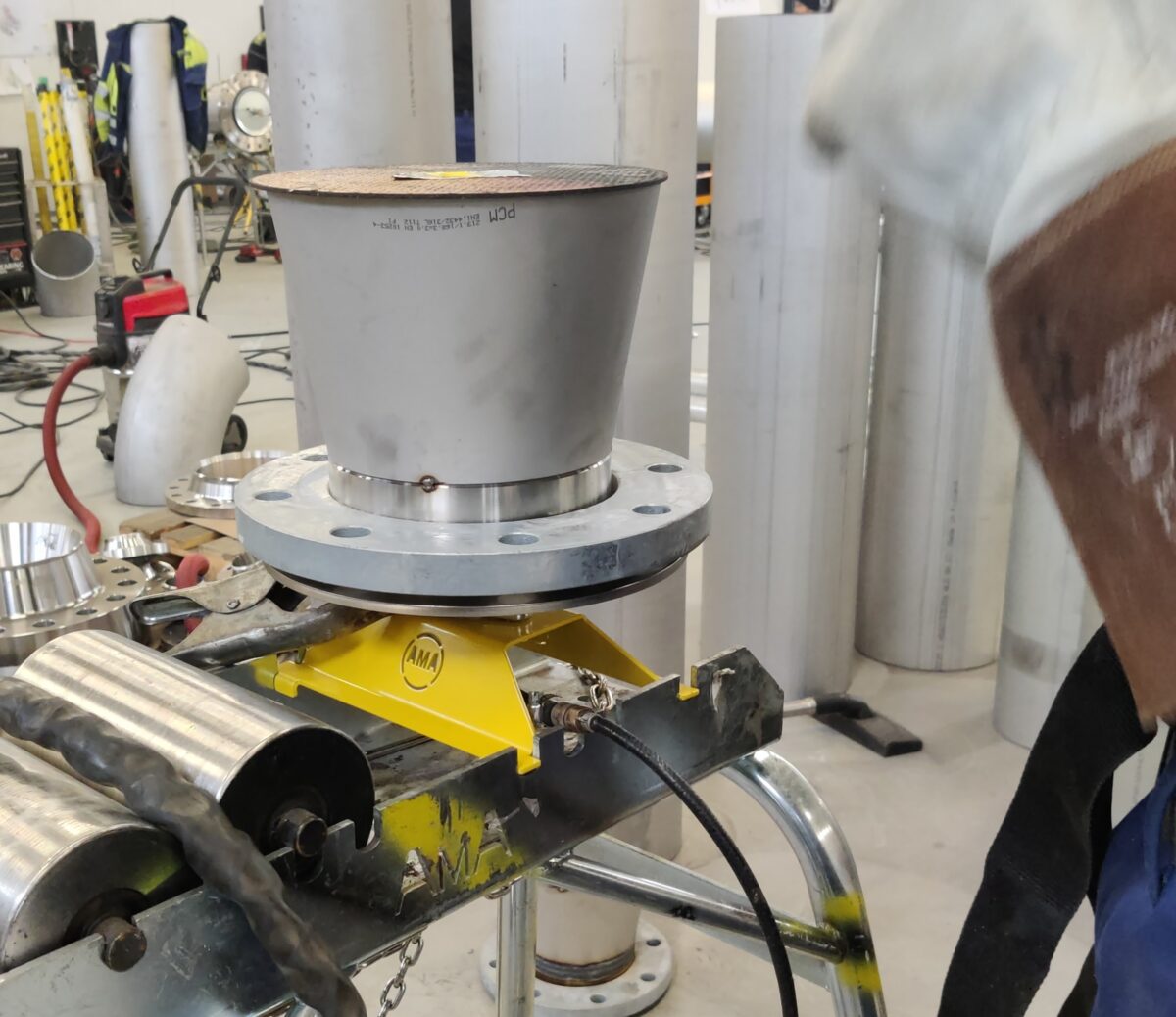
A purge gas turntable is most useful when you weld short pipe sections that you can place flat and rotate by hand, especially stainless steel parts where oxidation on the root side would ruin the weld. It lets you feed purge gas through the tabletop while you turn the part, so you keep the arc position steady and the root protected.
For process industry welders, this means cleaner roots, less gas waste and fewer interruptions. Below, we answer the main questions about when a turntable makes sense and when another method works better.
Which short pipe parts benefit most from turntable purging?
Short pipe parts such as spools, fittings, elbows, tees, reducers and flange assemblies benefit most from turntable purging. These parts are small enough to place on a table, but too awkward to purge and rotate with a long pipe setup. Stainless steel and other oxidation-sensitive materials gain the most.
Typical examples in process industry work include:
- Short spool pieces with a flange at one or both ends
- Elbow-to-pipe and tee-to-pipe joints prepared in the workshop
- Reducer and fitting welds on stainless steel lines
- Repeat batches of identical short parts where setup time adds up
The common factor is that you weld in a workshop or prefabrication area, where you can set the part on a stable surface. If you weld hygienic or acid-resistant stainless lines, a clean root is not optional, so controlled pipe purging pays back quickly in less rework.
How does a purge gas turntable work on short pipes?
A purge gas turntable works by feeding inert gas, usually argon, through the center of a rotating tabletop into the pipe part sitting on top. You rotate the table by hand while you weld, so the joint stays in a comfortable position and the inside of the pipe stays protected from oxygen.
The AMA Pipe Tools Purge Gas Turntable has a round stainless steel tabletop that turns on ball bearings. Gas comes in from the center through a rotating connector, so the hose does not twist or wind up as you turn the table. Grounding goes directly to the tabletop with cables, not through the bearings, which protects the bearings from welding current.
The table stands on three legs, so it does not wobble on a workbench. It also fits AMA pipe stand A, and you can fix it firmly in place with the stand’s chain. We make two sizes:
- Turntable 200 (product code 4030): for pipes up to DN200 (8″), weighs 4 kg
- Turntable 400 (product code 4040): for pipes up to DN400 (16″), weighs 9 kg
Both carry a maximum load of 100 kg.
Want to see the details and specifications? Read more about the AMA Purge Gas Turntable here: AMA Purge Gas Turntable
How does a turntable compare with other purging methods?
A turntable is faster and more convenient than plug-based or tape-and-dam methods for short parts, because the gas feed is built into the table and the part rotates freely. Purge plugs and kits remain the better choice for long pipes, installed lines and bends where you cannot lay the part on a table.
Turntable vs. purge plugs
Purge plugs seal the pipe ends and fill the section between them with gas. They work well on longer runs and fixed pipework. Our AMA Pipe Purge Kit uses triple silicone discs for an airtight seal, covers DN20 to DN150 and helps you cut gas use and purging time. For short parts on a bench, the turntable removes the need to fit and pull plugs for every joint.
Turntable vs. tape and dams
Taping the joint and sealing it with paper or foam dams is cheap, but it is slow and you throw the materials away each time. Tape can also leave residue near the weld. A turntable gives you a repeatable setup, so you spend your time welding instead of sealing.
The two methods also work together. Many workshops use purge plugs for long spools and installed lines, and a turntable for short pieces and batch work.
When is a purge gas turntable not worth using?
A purge gas turntable is not worth using when the pipe is too long or heavy to sit on the table, when you weld installed pipework on site, or when the material does not need back purging. In those cases, plugs, a pipe rotator or stands fit the job better.
Skip the turntable in these situations:
- Long pipes: Use purge plugs, and support the pipe on AMA pipe stands with a pipe rotator if you need rotation.
- Parts over 100 kg: The tabletop is rated for a maximum load of 100 kg.
- Parts above the size range: Pipes over DN400 (16″) need another approach.
- Carbon steel without purge needs: If oxidation on the root side does not matter, you gain little from purging.
- One-off field repairs: If the part stays in the line, you cannot bring it to a table.
If you weld a lot of long pipes, a pipe rotator such as the AMA Roller® is the more useful investment. For short parts, the turntable is the better fit.
How do you set up a turntable for clean welds?
To set up a turntable for clean welds, secure the table on a stable surface, connect the gas supply and grounding, seal the pipe part so gas stays inside, purge until the oxygen level is low enough, then weld while rotating the table by hand. Follow your welding procedure for the exact gas flow and purge time.
- Place the table firmly. Set it on a flat workbench, or fix it to AMA pipe stand A with the chain. The three legs keep it steady.
- Connect the gas. Attach the argon hose to the rotating connector at the tabletop center.
- Connect the grounding. Clamp the ground cable directly to the tabletop, not through the bearings.
- Position and seal the part. Place the pipe part on the table and close the open end so the gas stays inside and pushes out the air.
- Purge before you weld. Let the gas flow long enough to replace the air in the part. Use an oxygen monitor if your procedure requires one.
- Weld and rotate. Turn the table by hand as you weld, so the joint stays in your best working position and the arc stays steady.
- Check the root. Look at the inside of the weld. A clean, light color shows the purge worked.
The user is responsible for the success of the purging process, so always check your setup against your welding procedure and material requirements.
Have questions about which setup suits your parts? Contact us and we will help you choose.
Where can you get the right turntable and support?
A purge gas turntable is useful when you weld short, oxidation-sensitive pipe parts in a workshop and want clean roots with less gas waste and less fuss. It saves the most time on stainless steel spools, fittings and batch work, and it works best alongside plugs and rotators for longer pipes.
At AMA Pipe Tools, we are a family-owned company from Oulu, Finland, and we design and manufacture our own pipe welding tools. Our range covers pipe purge kits, pipe rotators, pipe stands, centering collars and purge gas turntables, all built for professionals who prepare and weld pipes in the process industry. We develop our products with feedback from welders, and we welcome your ideas for improvements.
To find the nearest local dealer, visit our authorized dealers page. We have retailers across the Nordic countries and several other European countries.