When is a wireless pipe rotator worth the investment?
Posted onIs a wireless pipe rotator worth it? Find out which welding projects justify the investment — and which don't.
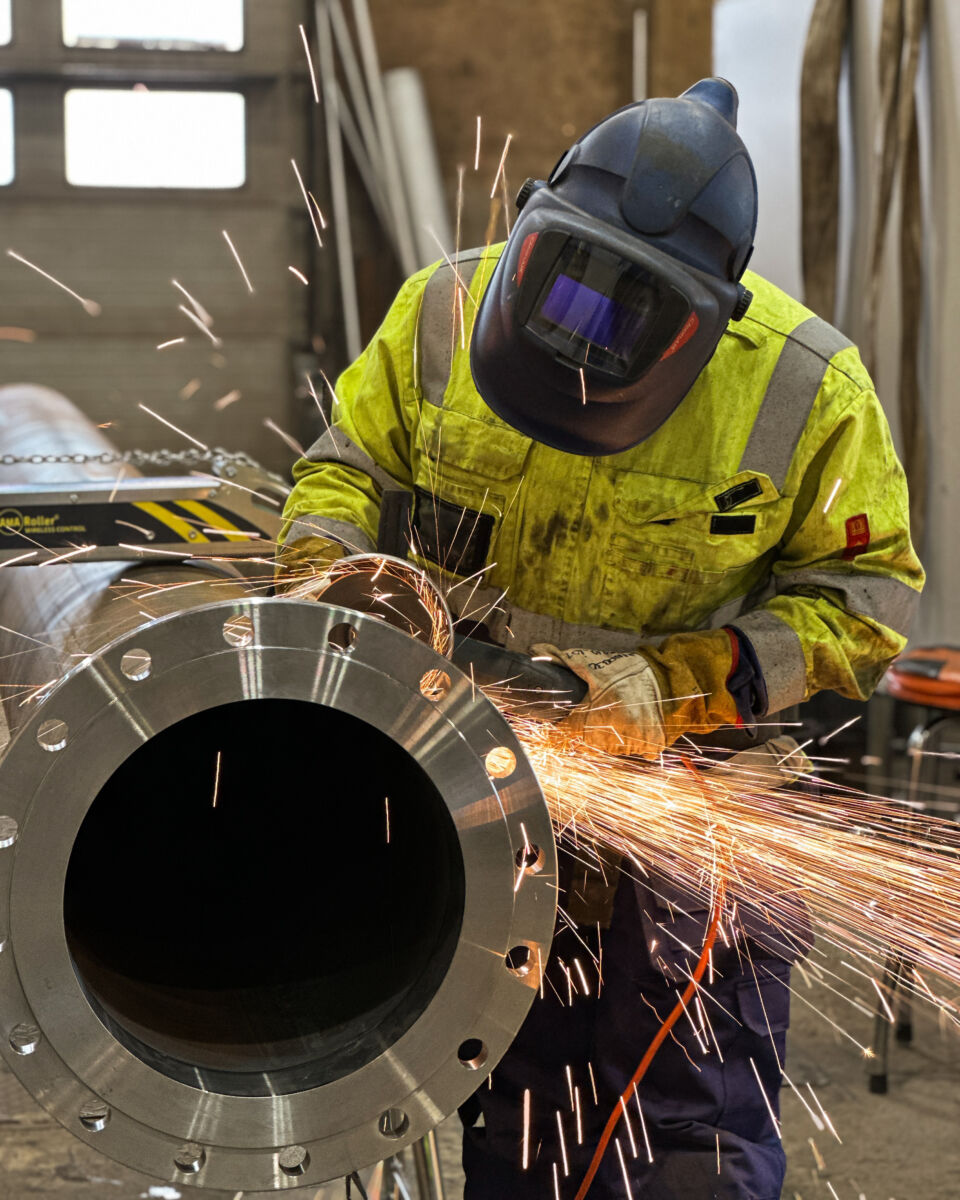
A wireless pipe rotator is worth the investment when your welding work involves repeated pipe rotation over longer distances, difficult positions, or high-quality seam requirements. For professional pipe welding in process industries, the productivity gains and weld quality improvements typically justify the cost within a relatively short period. Below, we answer the most common questions about wireless pipe rotators so you can make a confident decision.
How does a wireless pipe rotator actually work?
A wireless pipe rotator uses motorized drive rollers to rotate a pipe at a controlled speed while you weld. The pipe rests on the rollers, and a Bluetooth-connected control unit lets you adjust rotation speed and direction from up to 25 meters away, without a physical cable between you and the machine. You stay in your welding position while the pipe moves to you.
The control unit connects to the rotator via Bluetooth, and you can operate it either with a wireless foot pedal or a manual speed control knob on the handheld unit. This means both hands stay free for welding. The drive rollers grip the pipe and turn it at a consistent, adjustable speed, so the weld seam progresses steadily without you needing to stop, reposition, or interrupt the arc.
Our AMA Roller Premium wireless pipe rotator works exactly this way. It handles pipe diameters from 30 mm to 508 mm, runs on standard mains power, and reaches a maximum rotation speed of 1.7 m/min. The control unit charges via USB-C and uses a lithium-ion battery, so it stays charged throughout a full shift.
What types of pipe welding projects benefit most from a rotator?
Pipe welding projects that involve multiple pipes, demanding materials, or tight quality requirements benefit most from a pipe rotator. Process industry pipework, stainless steel fabrication, and prefabrication workshop production are the clearest cases where a rotator delivers real, measurable value. Any job where the welder would otherwise need to stop, reposition, and restart repeatedly is a strong candidate.
Prefabrication and workshop environments
In a prefabrication workshop, pipes move through multiple stages: cutting, tack welding, root pass, fill passes, and finishing. A rotator keeps the pipe turning consistently through all of these. The welder works in one ergonomic position from start to finish, which reduces fatigue, speeds up throughput, and produces seams that are far more uniform. Tack welds in particular become much cleaner because there are no interruptions for repositioning.
Process industry and demanding materials
Stainless steel, duplex, and other materials that require precise heat input and consistent travel speed are where a rotator earns its place most clearly. Welding these materials by hand while constantly changing position introduces variation in heat input and torch angle. A rotator removes that variable. It also enables MIG/MAG welding of pipes that would otherwise require TIG, which can significantly reduce time per joint.
How does a wireless pipe rotator compare to a corded model?
A wireless pipe rotator offers the same core rotation function as a corded model but removes the physical connection between the control unit and the machine. This means no cable running across the floor to the foot pedal or speed controller, which matters most on busy job sites or when you are welding long pipes where you need to move around the workpiece.
Corded rotators are reliable and cost less upfront. If your workshop is compact and you always weld in a fixed position close to the machine, a corded model like the AMA Roller Standard pipe rotator does the job well. The foot pedal is direct and simple, and there is no battery to manage.
The wireless version adds flexibility. On a job site with multiple trades working around you, fewer cables on the floor means fewer trip hazards and less interference. When you are handling long pipes and need to weld from different positions along the pipe’s length, the 25-meter Bluetooth range means you are never tethered to a fixed spot. For site work, the wireless model is the more practical choice.
What does a wireless pipe rotator cost versus manual pipe handling?
A wireless pipe rotator requires a higher upfront investment than manual pipe handling, but manual handling carries hidden costs that are easy to underestimate. These include slower welding speeds, more repositioning time, greater physical strain on welders, and less consistent weld quality. Over a full project or across a workshop’s annual output, these costs add up.
Manual pipe handling means the welder stops welding every time the pipe needs to turn. On a single joint, this might happen four or more times. Each stop breaks the arc, requires the welder to move, and introduces the risk of inconsistency in the seam. Multiply this across dozens or hundreds of joints per week, and the lost time becomes significant.
A pipe rotator eliminates those stops. Welding becomes continuous, the arc stays stable, and the welder stays in one position. For project managers and supervisors evaluating the investment, the relevant question is not the purchase price alone but how many joints per week the team welds and what a meaningful reduction in time per joint means for total labor cost. In most professional pipe welding operations, the math favors the rotator.
Ready to explore the wireless option?
See the AMA Roller Premium wireless pipe rotator and full specifications
When is a wireless pipe rotator not worth buying?
A wireless pipe rotator is not worth buying if your pipe welding volume is low, your pipe sizes fall outside the rotator’s range, or your work is entirely fixed-position welding where manual handling is already fast and simple. The investment makes sense when rotation genuinely changes how the work is done, not just as a convenience purchase.
- Very low volume: If you weld only a handful of pipe joints per week, the time savings do not accumulate enough to justify the cost.
- Pipes outside the supported range: Standard wireless rotators handle pipes from 30 mm to 508 mm in diameter. For very large pipes above this range, you need a heavy-duty rotator designed for that purpose.
- Fixed, short-run site repairs: If you are doing a single repair weld on a pipe in a fixed installation, there is no practical way to use a rotator. Manual welding is the only option.
- No access to mains power or charging: The wireless control unit needs charging, and the rotator itself runs on mains power. Remote sites without power access are not suitable.
The wireless feature specifically adds value when you need freedom of movement around the pipe or when cables on site create real problems. If neither of those applies, the standard corded rotator gives you the same rotation quality at a lower price point.
What should you look for when choosing a wireless pipe rotator?
When choosing a wireless pipe rotator, focus on pipe diameter range, wireless range and control options, rotation speed, build quality, and compatibility with your pipe stands. These factors determine whether the rotator actually fits your day-to-day work rather than just looking good on paper.
Pipe diameter range and load capacity
Make sure the rotator covers the pipe sizes you actually weld. A rotator that handles 30 mm to 508 mm covers most process industry applications, but confirm the maximum rotating load (measured in Nm) matches the heaviest pipes you handle. Heavier pipes need more torque to start and maintain rotation.
Wireless range and control flexibility
Check the Bluetooth range. A 25-meter range is enough for most site and workshop situations, including long pipe assemblies. Also check whether the control unit supports both foot pedal and manual speed control, since different welders prefer different setups. A USB-C rechargeable control unit is a practical feature that avoids proprietary chargers.
Compatibility with your pipe stand system
A pipe rotator only works well when it is properly supported. Check that the rotator mounts securely to a compatible pipe stand, and that you can add auxiliary stands for longer pipes. Rear wheels on the rotator unit make it much easier to move around the workshop or job site without needing extra hands.
Build quality and country of manufacture
Industrial pipe welding tools take a lot of punishment. Look for CE marking, heat-resistant drive wheels, and a manufacturer that stands behind the product with replacement parts. Tools made in Finland or other Northern European countries tend to meet the quality standards that process industry professionals expect.
For most professional welding operations in Northern and Western Europe, a wireless pipe rotator is a straightforward productivity tool rather than a luxury. It helps welders do better work with less physical effort, and it gives supervisors and project managers a more predictable output per shift. We design and manufacture our AMA Roller pipe rotators in Finland, and they are built for exactly this kind of professional use, whether in a prefabrication workshop or on an active job site.
If you want to see which AMA products are available through a dealer near you, find your nearest authorized AMA dealer. Or if you have a specific project in mind and want to talk through the right setup, contact us directly and we will help you find the right solution.