How do you improve pipe spool assembly accuracy?
Posted onControl three critical factors — end prep, alignment, and heat — to eliminate costly pipe spool errors.
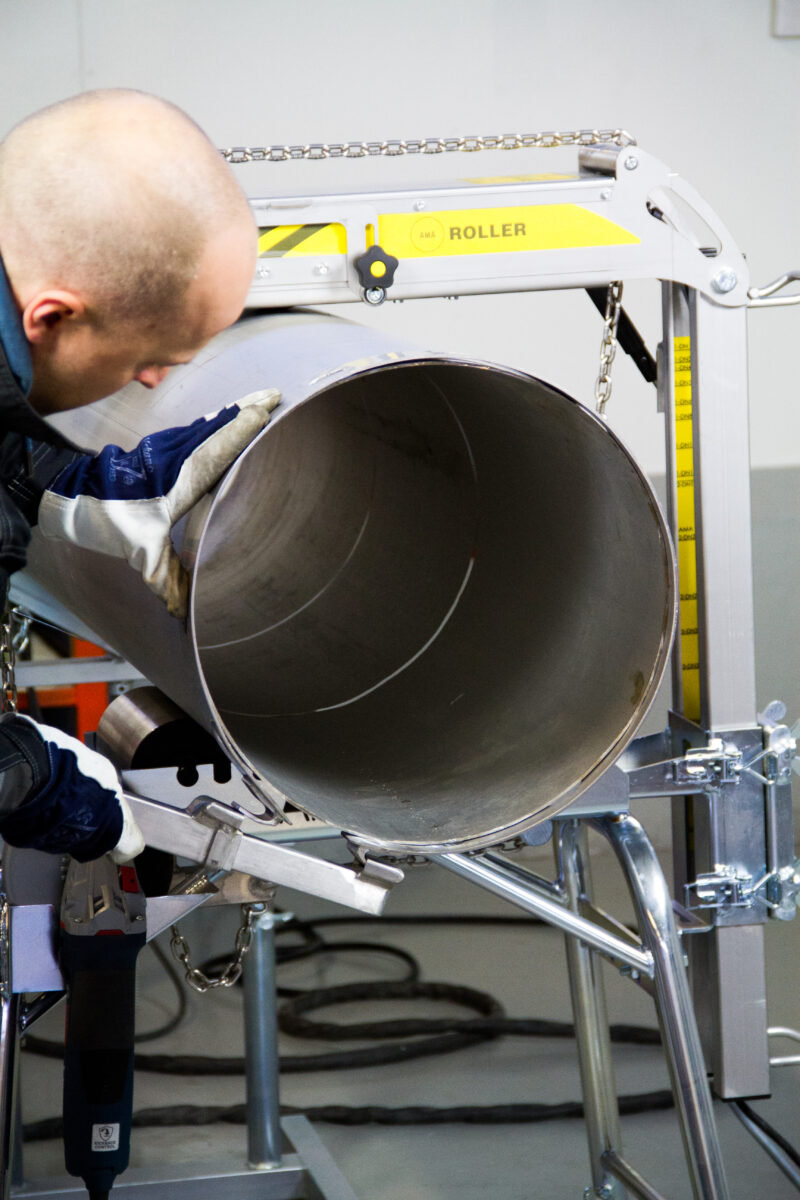
You improve pipe spool assembly accuracy by controlling three things: pipe end preparation, fit-up alignment, and heat management during welding. When each joint in a spool is properly prepared, correctly aligned, and welded with controlled heat input, dimensional errors stay small enough to meet isometric drawing tolerances. The sections below break down each factor and give you practical ways to address it.
What causes inaccuracies in pipe spool assembly?
Inaccuracies in pipe spool assembly come from accumulated errors across multiple joints. Each individual joint may be slightly off in angle, gap, or alignment, but when you stack several joints together into a spool, those small deviations add up. The most common root causes are poor pipe end preparation, incorrect root gap, high-low misalignment, welding distortion, and insufficient verification against isometric drawings.
In practice, the problems usually fall into one of three categories:
- Dimensional errors at the joint level — uneven root gaps, out-of-square cut ends, or wall thickness mismatches that create high-low conditions before welding even starts
- Positional errors during fit-up — pipes that are not properly aligned on their centerline, leading to angular or lateral offset at each joint
- Thermal errors introduced by welding — heat causes metal to expand and contract unevenly, pulling the spool out of its intended geometry
Understanding which category your errors fall into makes it much easier to apply the right fix. A spool that is consistently short, for example, is often a heat shrinkage problem. A spool that arrives on site with an angular offset at the flange is more likely a fit-up or tack welding problem.
How does pipe end preparation affect spool accuracy?
Pipe end preparation directly affects spool accuracy because a poorly prepared pipe end makes it impossible to achieve a consistent root gap or a square joint. If the cut end is not perpendicular to the pipe centerline, the resulting joint will have an angular offset that carries through to every subsequent connection in the spool.
The two most important aspects of pipe end preparation for pipe spool fabrication are:
- Squareness of the cut — the pipe end must be cut at a true 90-degree angle to the centerline. Even a small angular deviation becomes a measurable offset over the length of a multi-joint spool.
- Consistency of the bevel — the weld bevel must be uniform around the full circumference. An uneven bevel creates an uneven root gap, which leads to inconsistent weld penetration and distortion that is difficult to predict or compensate for.
Good pipe end preparation also means removing burrs, scale, and any deformation at the pipe end before fit-up. These small surface issues affect how well two pipe ends seat against each other and can introduce high-low misalignment even when the pipe itself is correctly dimensioned. Taking time at the preparation stage saves significantly more time than correcting a spool that has already been tack welded out of position.
What tools improve pipe alignment during fit-up?
The most effective tools for improving pipe alignment during fit-up are pipe stands, pipe rotators, and centering collars. Used together, they hold pipes at the correct height and centerline position, reduce manual handling errors, and make it straightforward to achieve consistent root gaps before tack welding begins.
Pipe stands and rotators
Adjustable pipe stands give you stable, height-correct support for each pipe section. When both pipes in a joint rest at the same centerline height, lateral high-low misalignment is much easier to eliminate. A pipe rotator like the AMA Roller Premium with wireless control goes further by letting you rotate the pipe continuously during tack welding, so you can work in the most comfortable position without repositioning yourself or the pipe between tacks. This produces more consistent tack welds and reduces the angular distortion that uneven tacking introduces.
Centering collars
For external alignment, centering collars are one of the most practical pipe alignment tools available. They clamp around the outside of both pipe ends at the joint and hold the two centerlines in register while you set the root gap and apply tack welds. AMA Centering Collars are made from stainless steel, come in sizes from DN65 to DN1500, and use a collar tightener fitted with thrust bearings to apply even clamping force around the full circumference. This keeps high-low misalignment to a minimum without requiring the welder to manually hold the pipes in position during tacking.
Using centering collars consistently across every joint in a spool is one of the most direct ways to reduce fit-up errors and improve overall pipe spool assembly accuracy. They are quick to apply and remove, which means they add very little time to the process while significantly reducing the risk of misaligned joints.
Read more about the AMA Centering Collar Set:AMA Centering Collar Set product page
How do welding distortion and heat input affect spool dimensions?
Welding distortion changes spool dimensions because heat causes the pipe material to expand during welding and contract as it cools. This contraction is not perfectly uniform, so the spool pulls slightly in the direction of the weld. Across multiple joints, these small movements accumulate into measurable dimensional changes in both length and angular position.
The main ways heat input affects pipe spool fabrication are:
- Longitudinal shrinkage — each completed weld joint causes a small amount of shortening along the pipe axis. In a spool with many joints, this can result in a finished spool that is noticeably shorter than the isometric drawing specifies.
- Angular distortion — uneven heat distribution around the joint causes one side to contract more than the other, pulling the spool out of its intended straight or angled geometry.
- Residual stress — high heat input leaves residual stress in the material that can cause the spool to shift slightly after welding is complete, particularly if it is moved or handled before fully cooling.
Controlling heat input through consistent welding parameters, balanced weld sequences, and proper interpass temperature management helps keep distortion predictable. When distortion is predictable, experienced fabricators can apply small pre-set corrections at fit-up to compensate for the expected movement. Using a pipe rotator to maintain a consistent welding position also helps distribute heat more evenly around the joint, which reduces angular distortion compared to welding a stationary pipe from one side.
What are the best practices for maintaining accuracy across multiple spool joints?
Maintaining pipe spool assembly accuracy across multiple joints requires a consistent process at every stage. The most effective approach is to treat each joint as a checkpoint rather than just a step, verifying dimensions and alignment before committing to the next weld.
The practices that make the biggest difference in pipe welding accuracy are:
- Standardize pipe end preparation — use the same cutting and beveling method for every joint so that root gap and bevel angle are consistent throughout the spool.
- Use alignment tools at every joint — centering collars and pipe stands should be standard equipment, not occasional aids. Consistent use of external alignment tools removes the variability that comes from manual positioning.
- Apply tack welds in a balanced sequence — place tack welds at evenly spaced positions around the joint to distribute the initial restraint force equally and reduce the risk of pulling the joint out of alignment.
- Control interpass temperature — allow each pass to cool to the specified interpass temperature before continuing. Overheating increases distortion and can affect material properties.
- Check dimensions after each joint — measure the spool against the isometric drawing after completing each joint, not just at the end. Catching a deviation early means you can compensate at the next joint rather than discovering the error when the spool is complete.
- Document your process — recording heat input, sequence, and measured dimensions for each spool gives you the data to identify patterns and refine your approach over time.
These spool assembly techniques are most effective when the whole team follows them consistently. Even one joint prepared or fitted differently from the rest can introduce an error that affects the overall spool geometry.
When should pipe spool assembly be verified against isometric drawings?
Pipe spool assembly should be verified against isometric drawings at three points: before fit-up begins, after tack welding each joint, and after completing the final weld on the spool. Checking only at the end of the process means any errors have already been locked in by completed welds, which makes correction expensive and time-consuming.
Here is what each verification stage should cover:
- Before fit-up — confirm pipe lengths, component positions, and overall spool layout against the isometric drawing. This is the easiest point to catch errors in cut lengths or component selection before any welding has taken place.
- After tack welding each joint — check the angular position and centerline alignment of the joint before completing the weld. Tack welds can still be broken and repositioned at this stage if a deviation is found.
- After the final weld — perform a full dimensional check of the completed spool, including overall length, flange face orientation, and branch positions. This is the formal acceptance check before the spool leaves the prefabrication workshop.
For spools with tight tolerances or complex geometry, some prefabrication shops also check dimensions after the first full weld pass rather than waiting for the joint to be complete. This is particularly useful when working with materials that are prone to distortion, such as thin-wall stainless steel or duplex grades.
Isometric drawings should always be the reference, not the previous spool in a series. Even when producing identical spools, verify each one independently because small variations in pipe material, heat input, or ambient temperature can cause different dimensional results from the same process.
Accurate pipe spool assembly comes down to doing the basics consistently at every joint: square pipe ends, proper alignment at fit-up, controlled welding, and regular checks against the isometric drawing. At Welner Oy, we design and manufacture pipe handling tools specifically for professionals who need reliable results in pipe prefabrication and on-site installation. Our AMA Centering Collars and pipe stands are built to help you achieve accurate fit-up faster and with less manual effort, whether you are working on a single spool or a full process piping project. Find your nearest stockist on our authorized dealers page, or contact us directly if you have questions about which tools suit your application.