How do you keep a comfortable welding position on large pipes?
Posted onRotate the pipe, not yourself—discover ergonomic tools and techniques that reduce welder fatigue and improve weld quality on large diameter pipes.
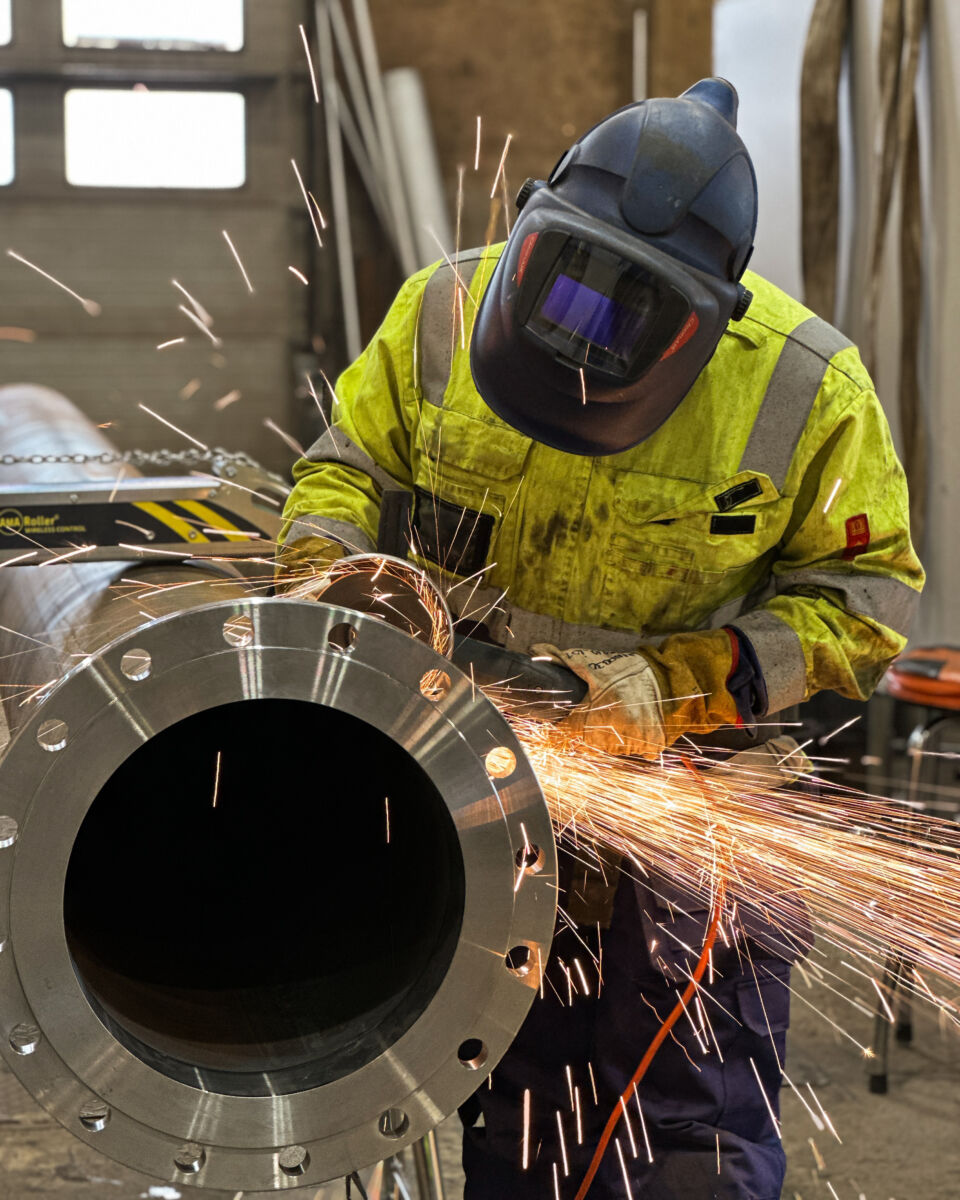
You maintain a comfortable welding position on large pipes by rotating the pipe toward you, rather than constantly repositioning yourself around it. A pipe rotator or roller stand lets you weld from one fixed, ergonomic position, which reduces physical strain and improves weld consistency. Below, we cover the key factors that affect posture, fatigue, and weld quality when working with large diameter pipe welding.
What makes large pipe welding physically demanding?
Large pipe welding is physically demanding because the sheer size and weight of the pipe force welders into awkward, sustained positions. Reaching overhead, crouching below the pipe centerline, or twisting sideways to follow the weld seam puts repeated stress on the back, shoulders, neck, and wrists. Over a full shift, that adds up fast.
Several factors combine to make large diameter pipe welding harder on the body than smaller pipe work:
- Pipe height and diameter force you to work at uncomfortable angles at different points around the joint
- Pipe weight limits how easily you can reposition the workpiece manually
- Long weld seams mean sustained awkward postures rather than brief ones
- Multiple passes require you to return to the same joint repeatedly, often in the same uncomfortable position
- Tight workspaces on site restrict how freely you can move around the pipe
The result is that welders who regularly work on large pipes are at higher risk of musculoskeletal strain than those working on smaller diameter pipe. This is not just a comfort issue. Fatigue directly affects weld quality, concentration, and safety.
How does pipe positioning affect weld quality?
Pipe positioning affects weld quality because the welding position determines how gravity acts on the molten weld pool. Welding in the flat or horizontal position gives you the most control over the pool. Overhead and vertical positions are significantly harder to control, increasing the risk of porosity, lack of fusion, and inconsistent bead geometry.
When a welder has to reach overhead or twist into an awkward angle, torch angle and travel speed become inconsistent. Even an experienced welder produces better results when working in a comfortable, repeatable position. This is especially true for demanding materials like stainless steel or duplex, where weld quality tolerances are tight.
Positioning the pipe so the active weld zone stays in the flat or slightly inclined position throughout the joint is one of the most effective ways to improve both quality and repeatability. This is why pipe rotation is so valuable: it keeps the weld zone at the same optimal angle regardless of where you are on the joint circumference.
What tools help maintain a comfortable welding position on large pipes?
The most useful tools for maintaining a comfortable welding position on large pipes are pipe rotators, roller stands, and pipe support systems. These tools let you keep the weld zone in the optimal position without physically repositioning yourself or manually turning the pipe.
Pipe rotators
A motorised pipe rotator is the single most effective tool for pipe welding ergonomics. It rotates the pipe at a controlled speed so the welder stays in one fixed, comfortable position while the joint comes to them. The AMA Roller pipe rotator handles pipe diameters from 30 to 508 mm and works with all manual welding methods including MIG, MAG, TIG, and covered electrode. The result is a consistently positioned weld zone and a seam that closely resembles the quality of a robot weld.
For even larger pipes, the AMA HD Rotator Set handles diameters up to 1,000 mm with motorised rollers and a battery that lasts a full working day, making it practical both in prefabrication workshops and on site.
Pipe stands and roller tables
Adjustable pipe stands support the pipe at the right working height so you are not bending down or reaching up. Used together with a rotator, they create a stable, ergonomic setup for the entire pipe assembly. AMA pipe stands are height-adjustable and handle a wide range of pipe diameters, making them useful across different project requirements.
For larger pipe assemblies or longer pipes, combining a motorised rotator with additional support stands keeps the pipe level and reduces the risk of it shifting during welding.
Want to see how the AMA Roller works in practice?
Read more about the AMA Roller pipe rotator
Should you rotate the pipe or move around it?
You should rotate the pipe whenever possible, rather than moving around it. Rotating the pipe keeps you in one ergonomic position throughout the weld, which reduces physical strain, improves weld consistency, and speeds up the work. Moving around the pipe means constantly adjusting your posture, torch angle, and technique to suit each position.
In a prefabrication workshop, rotating the pipe is almost always the better approach. The controlled environment makes it straightforward to set up a rotator and support stands, and the productivity gains are significant. Welders report fewer interruptions, more consistent seams, and less fatigue at the end of the shift.
On site, rotating the pipe is not always possible due to space constraints or fixed pipe runs. In those cases, minimising the time spent in the most demanding positions (overhead in particular) by adjusting pipe height and planning the weld sequence carefully makes a real difference. Where pipe rotation is possible even on site, a compact rotator like the AMA Roller Premium with wireless Bluetooth control gives you the freedom to manage rotation from up to 25 metres away, reducing the number of cables on site and giving you more flexibility in your working position.
How do you set up your workspace to reduce welding fatigue?
You reduce welding fatigue by setting up the workspace so the pipe is at the right height, the weld zone is always in an accessible position, and you have enough room to maintain a stable stance without twisting or overreaching. A well-organised workspace prevents the physical compromises that lead to fatigue and poor welds.
Here are the most practical steps for setting up an ergonomic pipe welding workspace:
- Set pipe height at elbow level or just below so you can weld without raising your arms above shoulder height or bending your back
- Use adjustable pipe stands to support the pipe at a consistent height along its length
- Position your rotator before you start so the pipe can be turned without stopping and repositioning mid-weld
- Keep your welding leads and gas hoses organised so they do not restrict your movement or create trip hazards
- Allow enough floor space to move freely around the workpiece without being forced into awkward positions by surrounding equipment
- Plan the weld sequence so you tackle the most demanding positions when you are freshest at the start of the shift
In a prefabrication workshop, these steps are easier to implement consistently. On site, the same principles apply but require more planning before work begins.
What body mechanics reduce strain during pipe welding?
Good body mechanics during pipe welding mean keeping your back straight, your elbows close to your body, and your weight balanced on both feet. Avoid reaching, twisting at the waist, or holding your breath while welding. These habits reduce cumulative strain on the muscles and joints most affected by welding work.
A few specific practices make a noticeable difference over the course of a shift:
- Keep the torch close to your body rather than extending your arm fully, which fatigues the shoulder quickly
- Use your whole body to guide the torch along the weld seam rather than relying only on wrist movement
- Take short breaks between passes to let muscles recover, especially during multi-pass welds on large pipe
- Change position regularly when you have to weld in a fixed position, shifting your weight and adjusting your stance to avoid static loading on one muscle group
- Use knee pads or a low stool when welding at low heights rather than crouching for extended periods
Body mechanics alone will not solve the ergonomics problem if the workspace setup forces you into poor positions. The most effective approach combines good technique with the right equipment and a well-organised workspace.
Maintaining a comfortable welding position on large pipes comes down to a combination of the right tools, a well-planned workspace, and good body habits. Rotating the pipe rather than moving around it is the single biggest improvement most welders and supervisors can make. At Welner, we design and manufacture pipe handling tools built specifically for professional pipe welding, from compact rotators for workshop use to heavy-duty systems for large diameter pipe. Our products are used across the Nordic countries and Europe in process industry and industrial pipe welding applications.
Find your nearest supplier through our authorised dealer network, or contact us directly if you have questions about which tools suit your specific pipe welding setup.